





Preparing your vehicle for shipping is the single most controllable factor in how smoothly the entire process goes. We've shipped over 235,000 vehicles at American Auto Shipping since 1999, and we can tell you without hesitation: the shipments that go perfectly -- zero issues at delivery, zero disputes, zero claims -- almost always start with a well-prepared vehicle and a thorough owner who took 30-45 minutes to follow a checklist. The shipments that generate problems? The owner who rushed, skipped the photos, left a garage full of personal items in the backseat, or forgot to mention the aftermarket alarm that screams at 2 AM in truck stop parking lots. This guide is your definitive preparation checklist, covering every vehicle type and every step from two weeks before pickup to the moment you sign the delivery Bill of Lading.
Start with a pre-shipping inspection at least one week before your pickup date. Walk around your entire vehicle slowly and deliberately. Look at every panel: front bumper, hood, both front fenders, both doors, both rear quarter panels, rear bumper, trunk or tailgate, and the roof. Get down low and look at the rocker panels and lower body trim. Check the wheels for curb rash. Look at the windshield and all glass for chips and cracks. Open every door and inspect the edges and thresholds. Check the headlights, taillights, and mirror housings for cracks. Note everything you find -- every scratch, every dent, every paint chip, every crack. This isn't about fixing anything before shipping. It's about knowing exactly what's there so you can verify nothing changed during transport.
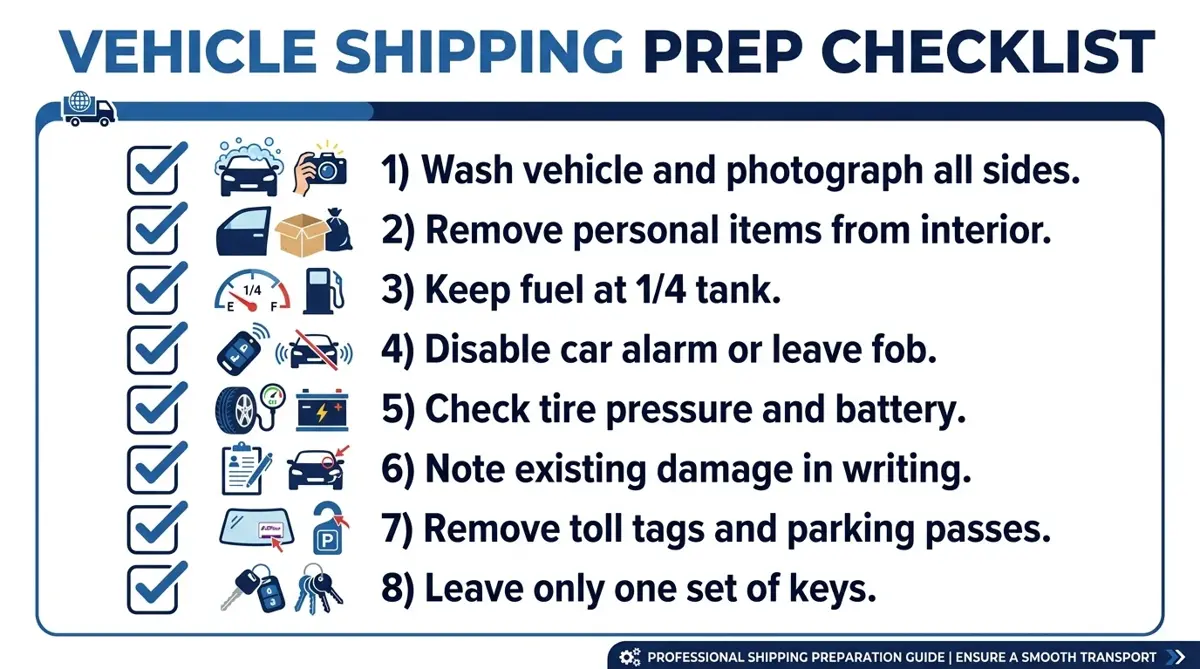
Vehicle Shipping Preparation Checklist — 8 Steps
Photo documentation is your most powerful protection, and most people don't take enough photos. We recommend a minimum of 30 photos, and here's exactly what to capture: front straight-on, rear straight-on, driver side full length, passenger side full length, front three-quarter from both sides, rear three-quarter from both sides, each individual wheel and tire, the roof (use a step stool if needed or shoot at an angle from each corner), close-ups of every area of existing damage (scratches, dents, chips, cracks), the dashboard and instrument cluster showing the odometer reading, the interior seats and door panels, the trunk or cargo area, and under the hood if there's anything notable. Time-stamp your photos -- most phones do this automatically. Then email the full set to yourself so you have a cloud-backed, verifiable record with a date and time that predates the carrier's arrival. This photographic evidence has settled thousands of damage disputes in the industry.
Remove all personal belongings from the vehicle -- and be thorough about it. Carriers are federally licensed to transport vehicles, not household goods or personal property. Items left in the vehicle are not covered by any carrier insurance policy, full stop. Beyond the insurance issue, loose items can shift during transport and damage the interior -- a water bottle rolling under the brake pedal, a laptop sliding off the seat and cracking the center console trim, a toolbox in the trunk becoming a battering ram. The most commonly forgotten items: phone chargers, sunglasses, garage door openers, parking passes, toll transponders (E-ZPass, SunPass, TxTag -- remove these or you'll accrue tolls during transport), dashcams and GPS units, CDs and USB drives, personal documents in the glove box, and that gym bag you forgot was in the trunk. Check every compartment: glove box, center console, door pockets, seatback pockets, under seats, trunk, and any aftermarket storage. If it's not permanently bolted to the vehicle, take it out.
Set the fuel level to approximately one-quarter tank. The driver needs enough fuel to start the vehicle, drive it onto the trailer, maneuver it into position, and drive it off at delivery. A quarter tank provides plenty for this while avoiding unnecessary weight. A full tank of gasoline weighs 100-150 pounds depending on tank size, and that weight matters on a carrier that's already managing 7-9 vehicles against federal weight limits. Don't leave the tank empty either -- the driver shouldn't have to find a gas station to move your car 50 feet onto a trailer. One-quarter tank is the industry standard sweet spot.
Disable or set to valet mode any aftermarket alarm systems. Factory-installed alarms that arm and disarm with the key fob are generally fine -- the driver will have your key. But aftermarket systems with motion sensors, tilt sensors, impact sensors, or proximity alerts will trigger during transport. Your vehicle will be loaded onto a moving trailer, driven over bumpy roads, and parked alongside other vehicles -- every one of those events can trigger a sensitive aftermarket alarm. A car alarm going off at 2 AM in a truck stop is a nightmare for the driver and everyone else parked there. If you can't fully disable the alarm, put it in valet mode. If there's no valet mode, disconnect the aftermarket alarm fuse (check your owner's manual or the alarm installer's documentation). Leave a note for the driver explaining any alarm quirks.
Check mechanical readiness. Your vehicle must be able to start, run, steer, and brake for loading and unloading. The battery should be fully charged -- a dead battery at pickup means the driver can't move your car, which delays the entire load. Tires should be inflated to the manufacturer's recommended pressure (found on the driver's door jamb sticker, not the tire sidewall). Under-inflated tires make the vehicle difficult to roll smoothly into wheel chocks and can cause issues with tie-down systems. If your vehicle doesn't run or drive, you must disclose this when booking. Non-running vehicles require special equipment (a winch or dolly) and cost $150-$300 more. Misrepresenting a non-running vehicle as operable creates major problems at pickup and can result in the carrier refusing the load.
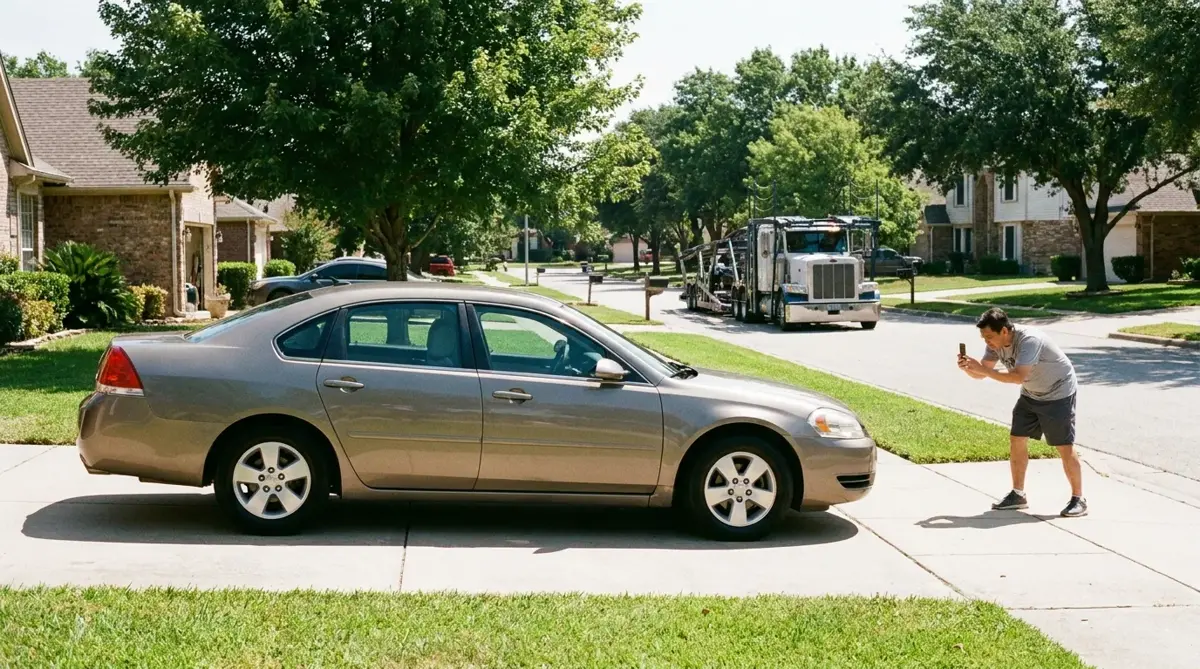
Person photographing car before shipping
Now let's cover vehicle-specific preparation. Convertibles: make sure the soft top is fully raised, latched, and secure. If you have a hard top, verify it's properly attached. Some carriers require convertible tops to be up during transport to prevent interior exposure to weather and debris. For vehicles with detachable hard tops (Jeep Wrangler, Bronco), the hard top should be on and secured. Trucks: lower any raised tonneau covers. Remove bed accessories that extend above the cab height -- toolboxes, racks, ladder racks. If you have a bed-mounted spare tire carrier, make sure it's secured. Duallys require carriers with adequate trailer width -- note this when booking. Lifted trucks need special attention: measure the total height including any roof racks or light bars. Vehicles exceeding 7 feet in height may not fit on standard multi-car carriers and require dedicated flatbed transport.
Classic cars and collectibles deserve extra preparation. Beyond the standard checklist, verify that all chrome trim pieces are securely fastened -- loose trim can catch wind and tear off at highway speeds. Ensure hubcaps or wheel covers are tight. If the vehicle has a known oil leak, place a drip tray or absorbent pad under the engine bay area and inform the driver. Classic cars with original paint may be more susceptible to tie-down marks -- ask the carrier about soft straps and padded contact points. Consider enclosed transport for any vehicle with irreplaceable paint, chrome, or bodywork. And make sure the vehicle is mechanically sound enough for loading -- an old car that barely idles may stall during loading, creating complications. A full charge on the battery and fresh fuel (with stabilizer if needed) go a long way.
Electric vehicles (EVs) and plug-in hybrids have specific shipping considerations. Set the state of charge between 50-80% -- enough for the driver to start and maneuver the vehicle, but not a full charge that adds maximum battery weight. Most EVs gain 500-1,000 pounds at full charge versus depleted -- and yes, that matters for carrier weight management. Put the vehicle in Transport Mode if available (Tesla, Rivian, and many other EVs have this feature) -- it disables automatic parking brakes, air suspension leveling, and other features that can interfere with tie-down and trailer loading. If your EV has air suspension, set it to the lowest ride height or transport mode setting. Disable any sentry or security camera modes that would drain the battery and potentially trigger alerts during transport. And make sure the driver knows how to shift the EV into neutral -- not every carrier driver is familiar with every EV's interface.
Pickup day preparation: be present if at all possible. When the carrier arrives, the driver will walk around your vehicle and complete a condition report on the Bill of Lading -- a detailed form that notes every existing scratch, dent, ding, and imperfection on a vehicle diagram. Walk with the driver during this inspection. Point out anything they might miss. Don't rush this process. Both you and the driver sign the BOL, and that signed document is the legal baseline for the vehicle's condition at the time of release. Have your keys ready -- you'll hand them to the driver (they'll be secured in a lockbox or key pouch for the duration of transport). Confirm the delivery address, contact information, and payment terms. Ask for an estimated delivery window. Make sure the area where your vehicle is parked has adequate access for a 75-foot car carrier -- residential streets can be tricky, so consider meeting the driver at a nearby parking lot or commercial area if needed.
Delivery day is equally important. When the carrier arrives, do not sign the delivery BOL until you've completed a thorough inspection. Walk around the entire vehicle and compare its current condition to the pickup BOL documentation. Check every panel, bumper, wheel, and glass surface. Open the doors. Check the interior. Look underneath if any components hang low. Compare against your pre-shipping photos on your phone. If the vehicle looks the same as when it left, sign the delivery BOL and you're done. If you notice any new damage -- even something small like a new scratch or ding -- note it on the delivery BOL before signing. Photograph the damage immediately. Do not let the driver pressure you to sign a clean BOL if there's damage. Your signature on a clean delivery BOL is an acknowledgment that the vehicle arrived in the documented condition, and it makes filing a damage claim extremely difficult after the fact.
Key Takeaways
- •How many photos should I take before shipping my vehicle?
- •Can I leave personal items in my car during shipping?
- •How do I prepare an electric vehicle for shipping?
Frequently Asked Questions
Take a minimum of 30 photos covering every panel, bumper, wheel, glass surface, the roof, interior, dashboard with odometer, and close-ups of all existing damage. Email the photos to yourself for a time-stamped, cloud-backed record. This documentation is your most powerful protection for damage claims.
We strongly recommend removing all personal belongings. Carriers are licensed to transport vehicles, not household goods. Personal items are not covered by any carrier insurance policy and can shift during transport, potentially damaging the interior. Check every compartment including glove box, console, door pockets, under seats, and trunk.
Set the battery charge to 50-80%. Enable Transport Mode if available (disables auto parking brake and air suspension). Set air suspension to lowest height. Disable sentry or security camera modes. Ensure the driver knows how to shift the EV into neutral. Do not ship at full charge, as it adds 500-1,000 pounds of unnecessary weight.
Note the damage on the delivery Bill of Lading before signing. Photograph the damage immediately. Do not sign a clean delivery BOL if there is any new damage. Contact your shipping company within 24 hours. You will need the pickup BOL, delivery BOL, your pre-shipping photos, and a repair estimate to file a claim.
Yes. A clean vehicle makes existing damage clearly visible for both your pre-shipping photos and the driver's Bill of Lading inspection. Dirt and grime can hide scratches and dents, which could lead to disputes about whether damage occurred during transport or was pre-existing.
Related Resources
Ready to Ship Your Vehicle?
Get a binding quote in 60 seconds. American Auto Shipping has shipped over 235,000+ vehicles since 1999.
Get a Free QuoteRelated Articles
First-Time Car Shipper's Checklist: Exactly How to Prep Your Vehicle for Pickup
Shipping a car for the first time? A few minutes of prep prevents most of the problems we see. Here's the exact pre-pickup checklist -- fuel level, personal items, that spare key, and the photos that protect you -- so pickup day goes off without a hitch.
Wildfire Season 2026: Move Your Vehicles Before the Evacuation Order, Not After
Fire agencies are calling for above-normal wildfire activity across California and the West this season. If you've got a second car, a classic, an RV, or a boat sitting at a property in fire country, the time to move it is before the evacuation order -- because once one drops, no carrier can come get it.
5 Mistakes That Delay Your Vehicle Shipment -- And How to Avoid Them
After coordinating over 235,000 shipments, we've seen the same handful of preventable mistakes cause the vast majority of delays. Here's what they are and exactly how to avoid every single one of them.
Military PCS Moves: Everything You Need to Know About Shipping Your Vehicle
PCS season is here, and if you’re a service member trying to figure out how to get your vehicle from your current duty station to your next one, this guide covers everything — from DITY move reimbursements to timing your shipment around orders.
More Guides
How to Ship a Car: The Complete 2026 Guide
A step-by-step walkthrough of the entire car shipping process, from getting your first quote to taking delivery. Everything you need to know to ship a vehicle in 2026.
Car Shipping Costs: Everything You Need to Know in 2026
A detailed breakdown of car shipping pricing by distance, vehicle type, transport method, and season. Learn what actually drives costs and how to avoid bait-and-switch quotes.
Open vs Enclosed Auto Transport: Which Is Right for You?
A head-to-head comparison of open and enclosed auto transport with pros, cons, pricing differences, and practical advice on when to use each method.
How Long Does It Take to Ship a Car?
Transit times by distance, factors that affect timing, pickup windows, and expedited options. Realistic timelines based on 27 years of shipping data.