





★ Key Takeaways
- ✓EVs now make up nearly 1 in 4 vehicles shipped, up from about 1 in 20 five years ago.
- ✓EVs are heavy and many carriers charge a weight surcharge of $75–$200 for vehicles over 5,000 pounds, since haulers are capped at 80,000 pounds gross.
- ✓Ship with the battery charged between 20% and 80% (never 100% or near zero) and at least 40–50% at pickup so the car can drive on and off and survive delays.
- ✓For Teslas, enable Transport Mode and disable Sentry Mode, summon, and auto-park before the carrier arrives.
- ✓Confirm coverage is high enough for EV repairs — a Tesla battery replacement runs $15,000–$25,000, and Rivian or Lucid packs cost even more.
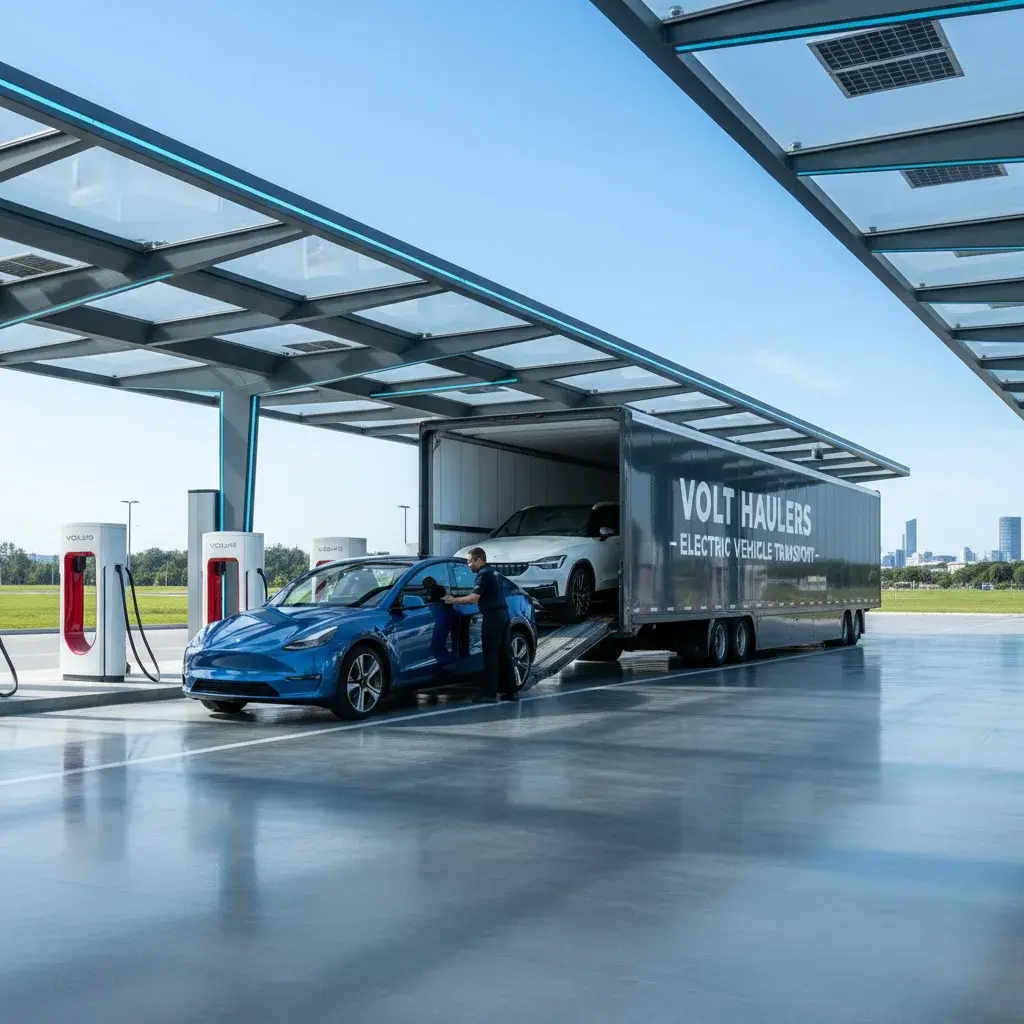
Five years ago, maybe one in twenty vehicles we shipped was electric. Today, it’s closer to one in four. The EV revolution isn’t coming — it’s here — and the auto transport industry has had to adapt fast. We’ve been shipping vehicles since 1999, and I can tell you that EVs have introduced a set of considerations that simply didn’t exist when every car on the trailer had a gas tank and a traditional drivetrain. If you’re shipping a Tesla, Rivian, Lucid, Ford Lightning, Hyundai Ioniq, BMW i-series, or any other EV, there are things you need to know that your neighbor who shipped their Camry last year didn’t have to think about.
The biggest factor is weight. EVs are heavy — significantly heavier than their gas-powered equivalents. A Tesla Model Y weighs about 4,400 pounds. A Rivian R1T tips the scales at over 7,000 pounds. A GMC Hummer EV? Over 9,000 pounds. Compare that to a typical midsize sedan at 3,300–3,500 pounds. This matters because car carriers have weight limits. A standard nine-car hauler is capped at 80,000 pounds gross vehicle weight by federal law. When you load three or four EVs onto that trailer instead of three or four lighter gas cars, you’ve eaten up weight capacity that might have held another vehicle. That’s why many carriers now charge a weight surcharge for EVs over 5,000 pounds — typically $75–$200 depending on the vehicle and route.
| Vehicle | Approximate weight |
|---|---|
| Typical midsize sedan | 3,300–3,500 lbs |
| Tesla Model Y | ~4,400 lbs |
| Rivian R1T | over 7,000 lbs |
| GMC Hummer EV | over 9,000 lbs |
Battery state-of-charge is another consideration that’s unique to EVs. Most carriers and the DOT recommend shipping an EV with the battery charged between 20% and 80% — never at 100% and never near zero. The reasoning is twofold. First, lithium-ion batteries are most stable in the mid-range of charge. A fully charged battery under stress — like the vibration and temperature fluctuations of being on a transport trailer for several days — carries marginally higher thermal risk than one at 50%. The risk is tiny, but carriers manage hundreds of vehicles and they want to minimize any variable they can. Second, the vehicle needs enough charge to be driven on and off the trailer at pickup and delivery. If your battery is dead, the carrier can’t load it without a flatbed or special equipment, which creates delays and added costs.
“The future of transportation is electric, and the future of auto transport is right here with it.”
Here’s something that surprises a lot of EV owners: you cannot charge your vehicle while it’s on the transport trailer. I know that sounds obvious, but I’ve had customers ask about it. The vehicle sits on the carrier for the duration of the trip, and there’s no way to plug it in. For most routes, this isn’t an issue — even at 50% charge, your EV will still have plenty of battery to drive off the trailer at delivery. But if you’re shipping an older EV with degraded battery capacity, or if there’s expected to be significant delays, make sure you’ve got at least 40–50% charge at pickup. I’ve seen a handful of situations where a vehicle arrived with a dead battery because the owner shipped it at 15% and the trip took an extra two days due to weather. Carrier had to arrange a portable charger at delivery — headache for everyone.
Ready to ship? Get a real price in 60 seconds.
Our AI marketplace pulls live bids from verified carriers running your route this week — no obligation, no spam.
Get My Free Quote →The question of open vs. enclosed transport is especially relevant for EVs, and not just for the reasons you might think. Yes, many EVs are expensive and owners want the protection of enclosed transport. But there’s a practical consideration too: EVs have massive flat battery packs on the undercarriage. On an open carrier, road debris kicked up by the trailer’s own wheels or other vehicles can occasionally strike the underside of transported cars. For a gas-powered car with a steel undercarriage, that’s usually no big deal. For an EV with a battery pack under there — even one protected by a skid plate — it’s worth considering whether enclosed transport gives you peace of mind. That said, the overwhelming majority of EVs ship just fine on open carriers. The battery packs are well-protected from the factory. But if you’re shipping a $100,000+ EV, the 40–60% premium for enclosed starts to look pretty reasonable.
Tesla-specific considerations come up a lot since they’re the most commonly shipped EV on our platform. First, put your Tesla in “Transport Mode” before the carrier arrives. This disables the parking brake, air suspension adjustments, and other systems that can complicate loading. It also prevents the car from waking up and activating Sentry Mode on the trailer, which would drain your battery filming the inside of a car hauler for three days. Second, make sure Sentry Mode is off. Third, disable any summon or auto-park features. You don’t want your car trying to park itself while strapped to a moving trailer. Sounds like a joke, but I’ve heard stories.
Insurance considerations for EVs are worth understanding. Standard carrier liability covers the vehicle against transport damage, but EV-specific components — particularly the battery pack — can be extraordinarily expensive to repair or replace. A Tesla battery replacement can run $15,000–$25,000. A Rivian or Lucid battery is even more. Make sure the coverage amount on your shipment is sufficient to cover not just body damage but potential drivetrain or battery damage. At American Auto Shipping, our marketplace carriers maintain coverage levels that account for the higher repair costs of modern EVs, and we can arrange supplemental coverage for high-value electric vehicles.
One trend I’m watching closely is the impact of EV growth on carrier economics. Because EVs are heavier, carriers are having to adjust how they load their trailers. A carrier that used to fit nine vehicles might only be able to safely carry seven or eight if several of them are heavy EVs. That means fewer vehicles per trip, which means higher per-vehicle costs to maintain profitability. Over time, this is putting upward pressure on transport pricing industry-wide — not just for EVs, but for all vehicles. It’s one of several factors contributing to gradual price increases across the auto transport market in 2026.
For EV owners preparing to ship: charge to 50–80%, enable Transport Mode if your vehicle has one, disable Sentry Mode and any autonomous features, remove any aftermarket charging adapters from the port, make sure your frunk and trunk are empty, and take photos of the entire vehicle including the undercarriage if accessible. Note any existing scratches, chips, or wheel damage. Do all of this before the carrier arrives so the pickup process is smooth and fast. Carriers are on tight schedules and a smooth pickup means everyone starts the trip on the right foot.
At American Auto Shipping, we’ve fully adapted our operations to the EV era. Our AI marketplace factors in vehicle weight when generating quotes, so EV owners get accurate pricing upfront without surprise surcharges. Our carrier network includes operators with specific EV transport experience and appropriate insurance coverage. And our concierge team can walk you through every EV-specific consideration for your particular vehicle. The future of transportation is electric, and the future of auto transport is right here with it. If you’ve got an EV to ship, we’re ready.
About the Author
Dave Armstrong is one of American Auto Shipping's longest-tenured team members. As content manager and strategist, most of what you read on this website came from him. He has extensive knowledge of the auto transport industry, having spent time in every role the business has to offer.