





★ Key Takeaways
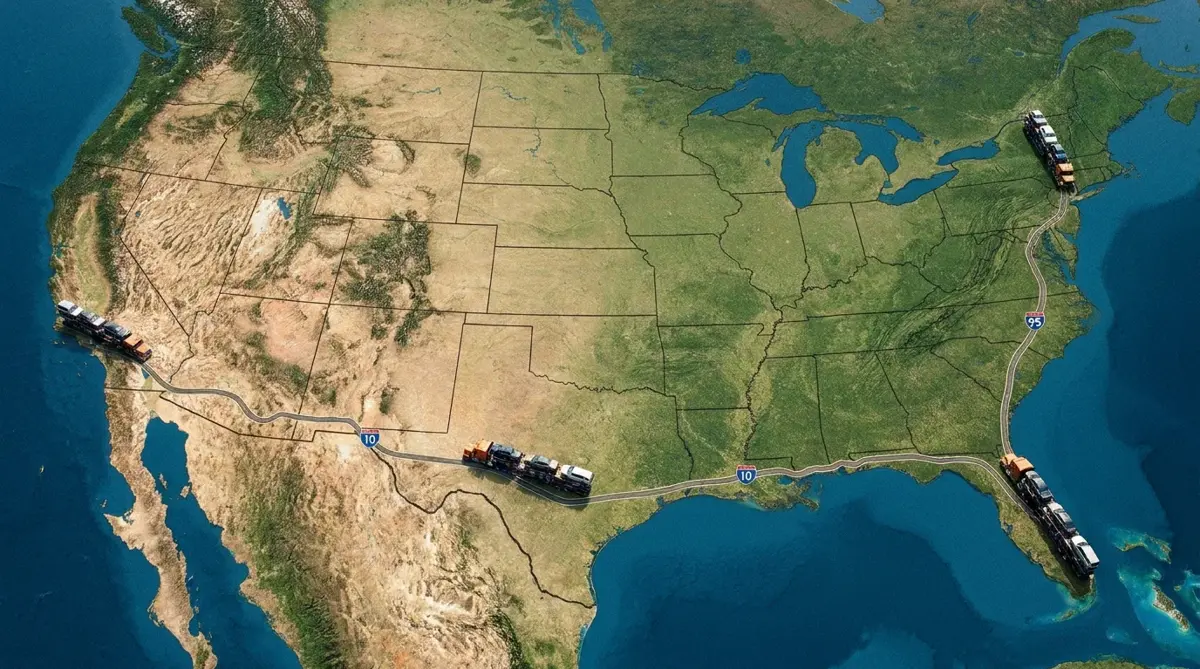
- ✓California → Florida is the #1 corridor by volume — roughly 2,500–2,800 miles, $1,100–$1,600 open, 5–8 day transit.
- ✓Distance isn't everything: carrier density, seasonal demand, and backhaul availability often matter more than raw miles.
- ✓"Reverse corridors" (FL→NY, FL→CA, TX→CA) now have genuine demand thanks to Sun Belt population growth — they're no longer cheap backhaul routes.
- ✓Book 2 weeks ahead in peak season and stay flexible on pickup date by 2–3 days to cut 15–25% off your rate.
Every year we see the same corridors dominate our booking volume -- and 2026 is no different. We've been doing this at American Auto Shipping since 1999 and we've shipped over 235,000 vehicles, so when we say these are the busiest lanes in the country, we're not pulling data from thin air. We're reading it straight from our AI-powered marketplace where carriers bid on shipments every single day.
The interesting thing about state-to-state shipping is that it's not just about distance. A 2,500-mile haul from California to Florida might actually be cheaper per mile than a 900-mile run from Ohio to Florida -- because carrier density, seasonal demand, and backhaul availability all play into the equation. Understanding which corridors are 'hot' and which are 'cold' at any given time is the difference between paying $900 and paying $1,400 for essentially the same service.
| Corridor | Distance | Open Price | Transit |
|---|---|---|---|
| California → Florida | 2,500–2,800 mi | $1,100–$1,600 | 5–8 days |
| New York → Florida | ~1,200 mi | $900–$1,300 | 3–5 days |
| California → Texas | ~1,400 mi | $800–$1,200 | 3–5 days |
| Texas → Florida | ~1,000 mi | $600–$1,000 | 3–5 days |
| Illinois → Florida | ~1,200 mi | $650–$1,000 | 3–5 days |
| New York → California | 2,700–2,900 mi | $1,100–$1,600 | 6–9 days |
Number one on the list -- and it's not even close -- is California to Florida. This corridor runs roughly 2,500 to 2,800 miles depending on the specific cities, and carriers typically follow I-10 across the entire southern tier through Arizona, New Mexico, Texas, Louisiana, Mississippi, Alabama, and into Florida. Open transport runs $1,100 to $1,600, enclosed $1,800 to $2,600. Transit time is 5 to 8 days. The snowbird migration from October through March makes this lane absolutely surge in demand, but even in summer it stays busy because of the sheer volume of online car purchases between these two states.
New York to Florida takes the number two spot. This is the classic East Coast snowbird run -- roughly 1,200 miles down I-95. Open transport averages $900 to $1,300 with a 3 to 5 day transit window. What makes this corridor interesting is the massive seasonal swing. From October through January, prices spike 20 to 30 percent as retirees head south. But from March through May, the return trip (Florida to New York) gets expensive instead as everyone heads back north. Smart shippers book two weeks before the rush hits.
Ready to ship? Get a real price in 60 seconds.
Our AI marketplace pulls live bids from verified carriers running your route this week — no obligation, no spam.
Get My Free Quote →California to Texas has exploded in the last three years. The tech migration from San Francisco and Los Angeles to Austin, Dallas, and Houston has turned this into one of the highest-volume corridors in the country. We're seeing prices between $800 and $1,200 for open transport on this 1,400-mile run, with 3 to 5 day transit. The I-10 corridor through the southern route is the most common, though some carriers take I-40 through northern routes depending on their next load.
Texas to Florida, Illinois to Florida, and New York to California round out the top six. Each has its own pricing dynamics and seasonal patterns. Texas to Florida is a relatively short 1,000-mile run that stays busy year-round thanks to Gulf Coast relocations. Illinois to Florida is the Midwest snowbird express -- Chicago to Miami or Tampa, driven by retirees and seasonal workers. New York to California is the big coast-to-coast haul that everyone thinks of when they picture auto transport.
What's changed in 2026 is the rise of the 'reverse corridors.' Florida to New York, Florida to California, Texas to California -- these used to be considered backhaul routes where carriers would offer discounts to fill empty trailers heading back. But with population growth in the Sun Belt states, these reverse routes now have genuine demand. We're seeing pricing on Florida to New York approach parity with the southbound route for the first time.
If you're shipping on any of these corridors, here are three things we've learned from 27 years in this business. First, book at least two weeks ahead during peak season -- carriers on these lanes fill up fast and last-minute bookings cost 15 to 25 percent more. Second, be flexible on your exact pickup date by 2 to 3 days -- this dramatically increases your carrier options and usually drops the price. Third, check our state-to-state corridor pages for detailed pricing, transit times, and seasonal tips specific to your route.
We've built dedicated pages for the top 20 state-to-state corridors on our website, each with current pricing ranges, key highways, seasonal notes, and popular city-to-city routes within that corridor. Whether you're shipping from California to Florida or Michigan to Arizona, you'll find specific, actionable data -- not generic estimates. Visit our state-to-state transport hub to find your corridor and get a quote that reflects what carriers are actually charging right now, not what some calculator guessed six months ago.
About the Author
Dave Armstrong is one of American Auto Shipping's longest-tenured team members. As content manager and strategist, most of what you read on this website came from him. He has extensive knowledge of the auto transport industry, having spent time in every role the business has to offer.
Learn More About Auto Shipping
Shipping To or From These Areas?
Auto transport by city