





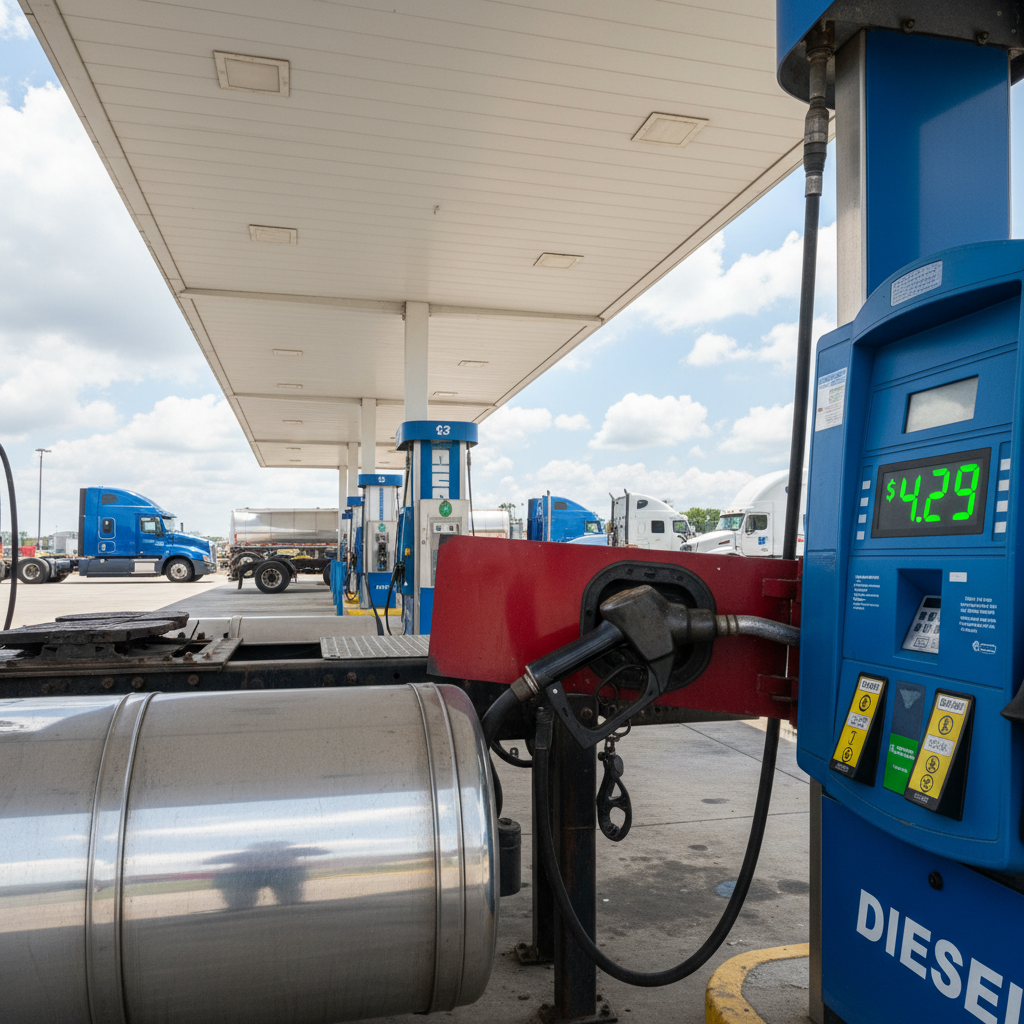
If you’ve been watching fuel prices this year, you’ve noticed the trend — and it’s not a fun one. The national average for diesel has climbed from around $3.65 per gallon in January to roughly $4.10 as of mid-May 2026. That’s about a 12% increase in less than five months. For the average person filling up their car, that’s annoying. For the auto transport industry, it’s a fundamental shift in operating economics that touches every single quote we generate. We’ve been in this business since 1999, and we’ve navigated diesel price swings of every variety — the $5+ diesel of 2008, the COVID-era collapse, the post-pandemic spike. Every time fuel moves significantly, it reshapes the market. And right now, it’s moving.
Here’s why diesel prices matter so much to your shipping quote: fuel is the single largest variable cost for auto transport carriers. It typically represents 25–30% of a carrier’s total operating costs. The other major expenses — truck payments, insurance, driver pay, maintenance, tires, permits — are relatively fixed. But fuel fluctuates week to week, and carriers can’t absorb a 12% increase in their biggest variable cost without adjusting their pricing. The math is straightforward. A nine-car hauler running a 2,500-mile coast-to-coast route gets roughly 5–6 miles per gallon. That’s about 420–500 gallons of diesel for a single trip. At $3.65 per gallon, that’s roughly $1,600 in fuel. At $4.10, it’s $1,800. That’s $200 more per trip — and when you divide it across nine vehicles, each shipment absorbs about $22 more just in fuel.
But here’s where it gets more nuanced — and why some routes are hit harder than others. Fuel costs don’t affect all routes equally. Longer routes obviously consume more diesel, so the absolute dollar impact is greater on a coast-to-coast run than a 500-mile regional move. But the routes that really get squeezed are the ones with a lot of deadheading — where carriers have to drive empty to reach a pickup location or reposition between loads. A carrier running a balanced route like Florida to New York and back stays loaded in both directions, so fuel costs are spread across revenue-generating miles. But a carrier picking up in rural Montana and delivering to a small town in Mississippi might be driving 300+ empty miles to reach the pickup point — burning diesel with zero revenue. When diesel prices climb, those inefficient routes see the steepest price increases.
The ripple effect goes beyond just the per-gallon price at the pump. When diesel climbs, carrier capacity tightens — particularly on marginal routes. Carriers are rational economic actors. When fuel costs spike, they become more selective about which loads they accept. A run that was marginally profitable at $3.65 diesel might be a money-loser at $4.10. So carriers drop those marginal routes and concentrate on the most efficient, highest-revenue corridors. That means less carrier availability on secondary routes, which pushes prices up further on those routes as shippers compete for fewer available trucks.
So what does this actually mean for your quote right now in May 2026? Based on what we’re seeing on our marketplace, the diesel increase has translated to roughly a 4–7% bump in average transport pricing compared to January. That’s less than the 12% fuel increase itself because fuel is only one component of total costs — but it’s real and it’s noticeable. On a $1,200 coast-to-coast shipment, you might be paying $50–$85 more than you would have in January. On a shorter regional move, the impact is smaller in absolute dollars but can be a higher percentage because the base price is lower.
Now, here’s what I really want to talk about — how to save money on auto transport even when diesel prices are working against you. First: be flexible on your pickup dates. Giving carriers a 3–5 day pickup window instead of demanding an exact date lets them work your vehicle into their existing route naturally, rather than making a special trip or deadheading to reach you. On our platform, flexible-date shipments consistently price 8–12% lower than exact-date requests — and that gap widens when fuel costs are elevated because carriers are even more focused on route efficiency.
Second: avoid peak-demand timing if you have any flexibility at all. Right now we’re heading into summer — the busiest season for auto transport. Demand peaks, capacity tightens, and pricing reflects it. If your shipment can wait until after Labor Day, you’ll likely see better rates as the market cools off. Even shifting by two weeks can make a difference. Our AI monitors these patterns in real time and adjusts quotes accordingly.
Third: consider terminal-to-terminal pickup or delivery if door-to-door isn’t critical. Door-to-door service means the carrier comes directly to your address, which is convenient but sometimes requires the carrier to navigate residential streets with a 75-foot trailer. If there’s a nearby commercial area or terminal where the carrier can easily access, choosing that option can trim $50–$100 off your quote.
Fourth — and this is specific to our platform — let our AI work for you. American Auto Shipping’s marketplace AI doesn’t just pull a number out of a database. It analyzes real-time carrier availability, current diesel prices, route demand, seasonal patterns, and carrier bidding behavior to find the best rate available for your specific shipment at this specific moment. When diesel prices spike, the AI recalibrates across the entire carrier network to find carriers who are already routing through your area — carriers who don’t need to deadhead, who are looking to fill a last spot on their trailer, who can absorb the fuel cost because their overall route economics still work.
Look — we can’t control diesel prices. Nobody can. OPEC decisions, refinery capacity, geopolitical events, seasonal demand patterns — these are forces way beyond what any auto transport company can influence. What we can control is how efficiently we match your vehicle with the right carrier on the right route at the right time. That’s what we’ve been doing for over 25 years and over 235,000 vehicles. Diesel will go up, diesel will go down — it always does. But regardless of where fuel prices sit, our job is to get you the most competitive rate possible while using verified, insured carriers who will get your vehicle there safely. Get a quote on our platform — it takes 60 seconds and it’s binding. The price you see is the price you pay, no fuel surcharge surprises after the fact.