





★ Key Takeaways
- ✓The savings are real but they come from the carrier's costs, not a coupon -- a second vehicle at the same address means one stop instead of two, and no repositioning between pickups.
- ✓Expect somewhere around 10 to 25 percent off the per-car rate when vehicles share an origin and destination. The tighter the match, the bigger the break.
- ✓Same address matters more than same city. Two cars at one house is a genuinely cheaper job; two cars forty minutes apart is close to two separate shipments.
- ✓A mixed load can be cheaper still -- pairing a light sedan with something heavy helps a carrier balance a trailer that is fighting the 80,000 lb federal weight limit.
- ✓Quote all the vehicles together from the start. Adding a second car after a carrier has already priced and planned the load rarely gets you the multi-car rate.
Somebody moving a household across the country asks us this constantly: is it cheaper to ship both cars together? Yes. But the answer people expect -- that there is a volume discount policy somewhere with a percentage printed on it -- is wrong, and understanding the real reason will get you a better price than asking for a discount ever will.
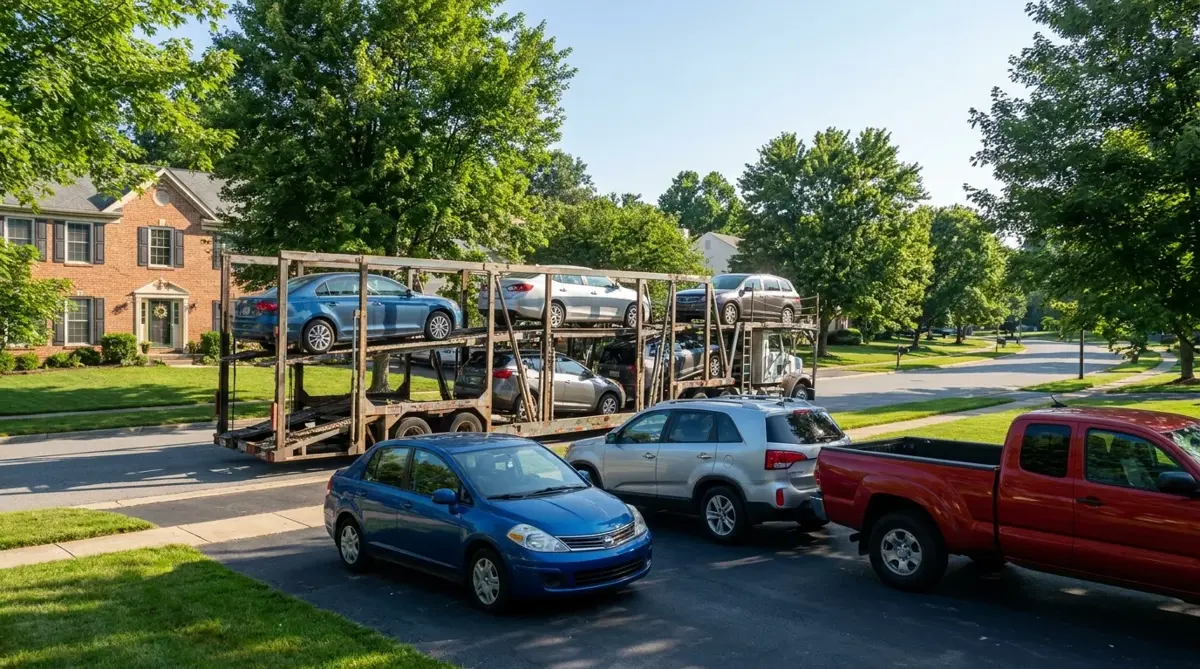
Think about the trip from the driver's side. A car hauler makes money by keeping the trailer full and the stops few. Every pickup is a scheduled appointment, a drive to a specific address, time spent loading and inspecting, paperwork, and then getting an eighty-foot rig back out of a residential street. That whole sequence costs the same whether the driver picks up one car or two while they are parked there. So when your second vehicle is standing in the same driveway, the carrier gets an additional paying vehicle for almost none of the additional cost. That gap is what comes back to you as a lower per-car rate.
| Scenario | Typical per-car savings | Why |
|---|---|---|
| Two cars, same address, same destination | 15 - 25% | One pickup, one delivery, zero repositioning |
| Two cars, same city, different addresses | 8 - 15% | Still one region, but two stops on the schedule |
| Two cars, same route, different cities | 5 - 10% | Shares the lane only -- the stops are separate jobs |
| Three or more from one location | 20 - 25% | Fills a meaningful share of the trailer in one stop |
| Mixed sizes from one location | Often the best rate | Helps the carrier balance weight under the 80,000 lb cap |
Which is why the single biggest factor is not how many cars you have -- it is how close together they are. Two cars at one house is a genuinely cheaper job and should price accordingly. Two cars at addresses forty minutes apart is, from the truck's perspective, two pickups, and the savings shrink toward nothing. If you have any flexibility about where the vehicles sit on pickup day, consolidating them at one address is the highest-value thing you can do, and it costs you a short drive.
“A carrier is not giving you a discount for buying in bulk. They are passing back the cost of a stop they no longer have to make.”
The delivery end works the same way. Vehicles going to one address unload together; vehicles going to two addresses in the same metro are two appointments. If you are moving a household and a second car is destined for a family member across town, it is worth asking whether both can land at the same place and get sorted out locally afterward.
Ready to ship? Get a real price in 60 seconds.
Our AI marketplace pulls live bids from verified carriers running your route this week — no obligation, no spam.
Get My Free Quote →There is a wrinkle that has become more valuable lately, and it comes from weight. Federal law caps a truck at 80,000 lbs, and with vehicles getting heavier -- especially EVs -- carriers increasingly run out of pounds before they run out of deck space. That means a driver hauling several heavy trucks is actively looking for something light to balance the load. If you are shipping a compact car alongside a full-size SUV, you are not just a convenient second vehicle, you are a useful one. We regularly see mixed-size pairs quoted better than two similar heavy vehicles.
Timing advice that saves people money: get all the vehicles on the quote from the beginning. Once carriers have bid on a single car and one of them has planned a load around it, adding a second vehicle is a change order, not a bundle. The trailer space may already be committed, the weight math already done. You will usually get quoted closer to a standalone rate for the addition. It costs nothing to list both up front, even if you are not certain the second one is going.
One thing that surprises people: the vehicles do not have to be identical, registered to the same person, or even going to the same final owner. Carriers care about geography and weight, not paperwork relationships. Snowbird couples with two cars, families sending a kid's car along with the household move, small dealers moving three units off a lot -- all of it is the same job to the truck.
The honest limit on this: if your two vehicles are in different states, there is no multi-car discount to be had, because there is no shared work to save. You have two shipments. Quote them separately and judge each on its own route, because pretending they are a bundle just makes the pricing harder to read.
American Auto Shipping is an AI-powered shipping marketplace -- not a broker, not a carrier. Listing several vehicles at once means carriers bid on the whole job, so you see what the bundle is genuinely worth to each of them rather than a fixed discount somebody invented. Get a free quote on our platform or call (800) 930-7417.
About the Author
Dave Armstrong is one of American Auto Shipping's longest-tenured team members. As content manager and strategist, most of what you read on this website came from him. He has extensive knowledge of the auto transport industry, having spent time in every role the business has to offer.