




The auto transport industry moves over 7 million vehicles a year in the United States, and the vast majority of those shipments go smoothly. But mixed in with the thousands of legitimate brokers and carriers are bad actors who cost consumers millions of dollars annually through fraud, deception, and outright theft. We've been at American Auto Shipping since 1999 -- 27 years in this business -- and we've watched the scam playbook evolve from newspaper classified ads to sophisticated websites with fake reviews, AI-generated testimonials, and cloned FMCSA filings. This guide is the most comprehensive breakdown of auto transport scams we've ever written, and it exists because we're tired of seeing people get burned by companies that give our entire industry a bad name.
The most common scam in auto transport is the bait-and-switch quote, and it's been the industry's biggest problem for as long as we've been in business. Here's exactly how it works, step by step. You request quotes from several companies. Most come back between $900 and $1,100 for your route. But one company comes in at $550 -- dramatically lower. You think you found a deal. You book with the low-price company and pay a $200 deposit. Days pass with no pickup. A week goes by. You call, and they tell you carriers aren't accepting loads at that price. They 'need' to increase to $950 to get your vehicle moving. Now you're stuck: you've paid a non-refundable deposit, you might have a relocation deadline, and the other companies you passed on may have already booked their carrier space. The final price ends up higher than the legitimate quotes you rejected. This isn't a rare occurrence -- it's a systematic business model used by hundreds of companies in the industry.
How do you spot a bait-and-switch before you fall for it? The clearest red flag is a quote that's 25-30% or more below the average. Auto transport is a real business with real costs: diesel fuel, driver wages, truck payments, insurance, tire replacement, maintenance. These costs don't vary drastically from company to company. If four companies quote $900-$1,100 and one quotes $550, the $550 company isn't more efficient -- they're lying about the price. At American Auto Shipping, our AI analyzes real-time carrier rates, fuel costs, route demand, and seasonal patterns to generate binding quotes. A binding quote means the price doesn't change. Period. Ask any company you're considering: is this quote binding or non-binding? If they hedge, deflect, or say 'it's an estimate,' walk away.
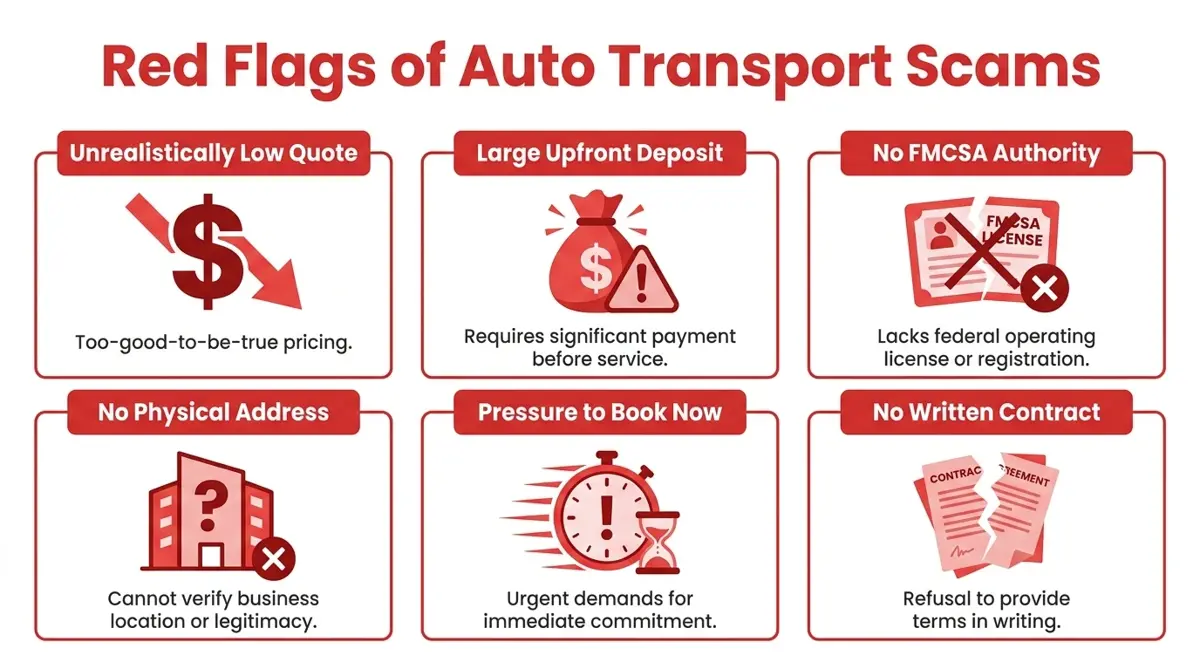
6 Red Flags of Auto Transport Scams — Infographic
Deposit scams are the second most common fraud pattern. Here's how they work: you book with a company and pay a deposit of $200-$500. The company never dispatches a carrier. When you call to check status, you get voicemail, excuses, or vague promises. Eventually you try to cancel and get your deposit back. The company either ghosts you entirely, claims the deposit is non-refundable because they 'attempted' to find a carrier, or makes the cancellation process so frustrating that you give up. Some of these operations churn through hundreds of deposits per month -- collecting $200 here, $300 there -- with no intention of ever moving a single vehicle. They're deposit mills, not transportation companies. To protect yourself: always pay deposits with a credit card (never debit, wire transfer, Zelle, Venmo, or cash app). Credit cards give you chargeback rights if the company fails to provide service. Read the cancellation policy before booking. And be suspicious of deposits over $300 for standard open transport.
Verifying a company's legitimacy takes about 10 minutes and can save you thousands. Start with the FMCSA (Federal Motor Carrier Safety Administration) at FMCSA.gov or safer.fmcsa.dot.gov. Every legitimate broker and carrier must have an active MC (Motor Carrier) number. Search by company name or MC number and confirm: the license status is 'Active -- Authorized,' the entity type matches what they claim (broker vs. carrier -- these are different authorizations), the insurance filing is current and not expired, and the company name and address match what's on their website. If a company can't provide their MC number, or their record shows 'Inactive,' 'Revoked,' or 'Not Authorized,' they are operating illegally. Do not give them your vehicle or your money.
Beyond FMCSA verification, check multiple review sources. Google Business reviews are the hardest to fake at scale -- look for a company with at least 50+ reviews and a pattern of legitimate, detailed feedback (not generic one-liners). The Better Business Bureau (BBB) tracks complaint patterns -- a company with an 'F' rating or dozens of unresolved complaints is a clear warning sign. Transport Reviews (transportreviews.com) is an industry-specific platform where verified customers leave feedback. Check all three. A legitimate company will have a presence on all of them. A scam operation might have a polished website but thin or nonexistent review profiles. And be skeptical of reviews that seem too perfect, too similar, or posted in suspicious bursts -- review manipulation is common in this industry.
Here's a scam pattern that's growing in 2026: company cloning. Scammers create a website that closely mimics a legitimate company -- similar name, similar logo, sometimes even stealing the real company's MC number and reviews. They advertise heavily on Google Ads to appear at the top of search results, collect deposits, and disappear. How to spot a clone: compare the MC number on the company's website to what's actually registered at FMCSA.gov. Call the phone number listed on the FMCSA record (not the website) and confirm you're speaking with the real company. Check the website's domain registration date -- a site registered 3 months ago claiming '15 years of experience' is a red flag. Verify the physical address on Google Maps.
Large upfront deposits and unusual payment requirements are major warning signs. A legitimate auto transport broker typically collects $50-$200 at booking, with the remaining balance paid to the carrier at delivery (usually by cashier's check, money order, or cash). This payment structure protects you because you maintain leverage until the service is completed. Scam operators want maximum money upfront: full prepayment before any service, deposits of $500+, or payment through non-reversible methods like wire transfer, cryptocurrency, Zelle, Venmo, or Cash App. Once money leaves your account through these channels, it's essentially gone. Credit card chargebacks are your most powerful consumer protection tool -- always use a credit card for any auto transport deposit.
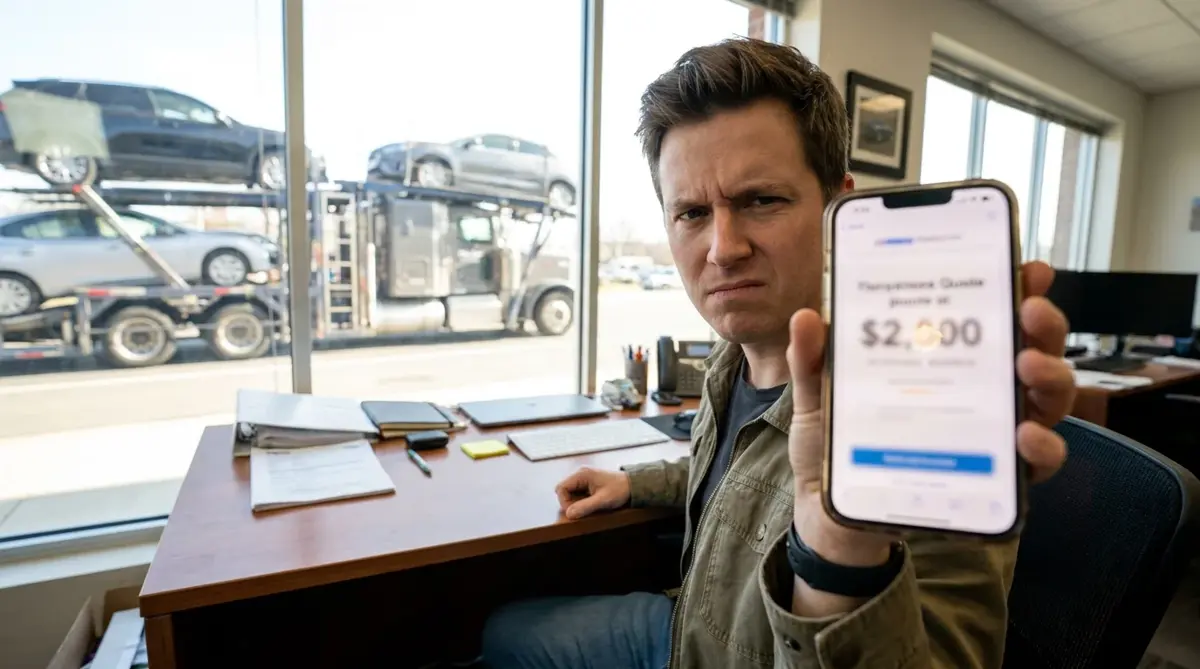
Person reviewing suspicious auto shipping quote
Hostage loads are a particularly nasty scam. You book transport, and a carrier picks up your vehicle. During transit, the carrier demands additional payment beyond the agreed price -- sometimes hundreds or thousands of dollars more -- and threatens to hold your vehicle until you pay. This is technically extortion, but it puts you in an extremely difficult position: your car is on their truck, possibly in another state. Legitimate carriers don't do this. The price on the Bill of Lading is the price you pay. If a carrier tries to renegotiate after loading your vehicle, contact the broker immediately, document everything in writing, and if necessary, contact law enforcement and the FMCSA. At American Auto Shipping, our binding quotes and verified carrier network specifically prevent this -- the carrier agrees to the price before they ever touch your vehicle.
What legitimate companies do differently -- and how to tell. They provide binding quotes in writing before you commit. Their FMCSA license is active and verifiable. They have a physical business address you can confirm on Google Maps. They have a substantial review history across multiple platforms -- not just their own website. They explain the process clearly, answer questions without pressure, and don't use urgency tactics ('this price expires in one hour'). They collect reasonable deposits with clear cancellation policies. They provide the carrier's name and MC number before pickup so you can verify independently. They have been in business for years, not months. And they have real employees who answer the phone -- not just an answering service or voicemail maze.
If you've already been scammed, here's what to do. First, if you paid by credit card, initiate a chargeback immediately through your card issuer. Explain that the company failed to provide the contracted service. Credit card companies have robust dispute processes, and auto transport scams are a recognized category. Second, file a complaint with the FMCSA at nccdb.fmcsa.dot.gov -- this goes into the company's federal record and can lead to enforcement action. Third, file a complaint with the Federal Trade Commission (FTC) at reportfraud.ftc.gov. Fourth, contact your state's Attorney General office -- many states have consumer protection divisions that investigate transport fraud. Fifth, report the company to the BBB. Sixth, leave honest reviews on Google and Transport Reviews to warn other consumers. The more reports filed, the faster regulators act.
American Auto Shipping has been in business since 1999 -- that's 27 years. Our MC number is verifiable at FMCSA.gov. We're BBB A+ rated. We've shipped over 235,000 vehicles. Every quote on our platform is binding. Every carrier in our network is verified for active operating authority, safety records, and current insurance. Our AI-powered marketplace eliminates the bait-and-switch problem entirely because carriers bid based on real-time market rates -- not manipulated lowball numbers. We have a physical headquarters in Las Vegas, a real team you can call during business hours, and a reputation built over more than a quarter century. If you're nervous about auto transport scams -- and you should be cautious -- verify our credentials, read our reviews, and compare our process to anyone else in the industry. Transparency is our competitive advantage.
Key Takeaways
- •What is the biggest red flag for an auto transport scam?
- •How do I verify if an auto transport company is legitimate?
- •Should I pay an auto transport deposit with a credit card or debit card?
Frequently Asked Questions
A quote that is 25-30% or more below the market average is the single biggest red flag. Legitimate auto transport costs are based on real expenses (fuel, driver pay, insurance) that do not vary drastically between companies. Unrealistically low quotes are bait-and-switch tactics designed to collect your deposit before raising the price.
Search for their MC number at FMCSA.gov or safer.fmcsa.dot.gov. Confirm the license status is Active-Authorized, insurance filings are current, and the company name/address match their website. Also check Google reviews, BBB rating, and Transport Reviews. A legitimate company will be verifiable across all sources.
Always use a credit card. Credit cards provide chargeback protection if the company fails to deliver service. Debit cards, wire transfers, Zelle, Venmo, and Cash App offer little to no recourse once payment is sent. Never use non-reversible payment methods for auto transport deposits.
Initiate a credit card chargeback immediately. File complaints with the FMCSA (nccdb.fmcsa.dot.gov), the FTC (reportfraud.ftc.gov), your state Attorney General, and the BBB. Leave honest reviews on Google and Transport Reviews to warn other consumers. The more reports filed, the faster regulatory action is taken.
A binding quote is a legal commitment -- the price cannot change regardless of market conditions. A non-binding quote is just an estimate that can be increased at any time. Non-binding quotes from low-cost competitors frequently increase 30-50% before pickup. Always insist on a binding quote before booking.
Related Resources
Ready to Ship Your Vehicle?
Get a binding quote in 60 seconds. American Auto Shipping has shipped over 235,000+ vehicles since 1999.
Get a Free QuoteRelated Articles
5 Mistakes That Delay Your Vehicle Shipment -- And How to Avoid Them
After coordinating over 235,000 shipments, we've seen the same handful of preventable mistakes cause the vast majority of delays. Here's what they are and exactly how to avoid every single one of them.
How to Avoid Issues With Your Auto Transport Broker
Shipping a car is not always an easy process. But it's a lot easier if you use an auto transport broker to help you get it done. If you've ever shipped a car, chances are you know how brokers work and what they do. You've likely seen reviews of their services, both good and bad, and that may have sk...
How to Avoid Issues With Your Auto Transport Carrier
When you ship a car, it's important that you understand how the process works and how it's actually moved. From the broker to the auto transport carrier, you need to know who you're dealing with, what they do, and how they fit into your shipment. We talk a lot about that here in this blog, mostly be...
Four Common Auto Transportation Problems (And How to Avoid Them)
Any industry that moves goods from one location to another will invariably experience issues at one point or another. Let's face it - there's a lot of moving parts when it comes to logistics, and sometimes things don't go smoothly. The same goes for auto transport . Auto transportation problems crop...
More Guides
How to Ship a Car: The Complete 2026 Guide
A step-by-step walkthrough of the entire car shipping process, from getting your first quote to taking delivery. Everything you need to know to ship a vehicle in 2026.
Car Shipping Costs: Everything You Need to Know in 2026
A detailed breakdown of car shipping pricing by distance, vehicle type, transport method, and season. Learn what actually drives costs and how to avoid bait-and-switch quotes.
Open vs Enclosed Auto Transport: Which Is Right for You?
A head-to-head comparison of open and enclosed auto transport with pros, cons, pricing differences, and practical advice on when to use each method.
How Long Does It Take to Ship a Car?
Transit times by distance, factors that affect timing, pickup windows, and expedited options. Realistic timelines based on 27 years of shipping data.