





If you've ever wondered why your car shipping quote changed between January and June -- or why two quotes for the same route, same vehicle, same distance came in $200 apart -- the answer is almost always fuel. Diesel prices are the single most volatile cost input in the auto transport industry, and they ripple through every quote, every carrier decision, and every route in the country. We've been in this business at American Auto Shipping since 1999, and we've watched diesel prices swing from $1.50 a gallon to over $6.00 a gallon and back again. Every swing changes the math for every shipment. This guide breaks down exactly how fuel prices affect what you pay to ship a vehicle -- with real numbers, not hand-waving.
Let's start with the basics: fuel is 30-40% of a carrier's total operating costs. That's not a rough estimate -- it's consistent across the industry, confirmed by the American Transportation Research Institute (ATRI) which tracks trucking costs annually. For a typical open car hauler running a cross-country route, the math looks like this: a truck-and-trailer combination pulling 7-9 vehicles gets roughly 5-7 miles per gallon of diesel. A 2,500-mile coast-to-coast run burns approximately 350-500 gallons. At $4.00/gallon, that's $1,400-$2,000 in fuel alone for one trip. At $5.00/gallon, it's $1,750-$2,500. At $3.50/gallon, it's $1,225-$1,750. That $500-$750 swing in fuel cost gets divided across the 7-9 vehicles on the trailer -- which means each shipper's price moves $55-$105 per vehicle just from fuel alone. And that's before the carrier adjusts their margin to account for uncertainty.
The historical correlation between diesel prices and auto transport rates is remarkably consistent. Our data going back to 2005 shows that when the national average diesel price increases by $0.50 per gallon, auto transport rates rise 8-12% within 30-60 days. The lag exists because carriers don't reprice every load instantly -- they adjust as they book new loads and renegotiate with brokers. Here's the timeline we've observed over two decades: diesel spiked in 2008 to $4.80/gallon and car shipping rates hit record highs. In 2020, diesel dropped to $2.40 during COVID lockdowns, and transport rates fell 15-20% as carriers competed for scarce loads. In 2022, diesel surged past $5.50 following the Ukraine conflict, and cross-country shipping rates jumped from an average of $1,100 to $1,400+. By mid-2023, diesel eased back to $3.80-$4.20, and rates followed it down. The pattern is clear and repeatable.
In 2026, diesel prices have settled into the $3.60-$4.20 per gallon range nationally -- lower than the 2022 spike but above pre-2020 levels. Several factors are shaping the current diesel market: domestic refining capacity has stabilized after pandemic-era disruptions, global demand from China and India continues to put upward pressure on crude, the shift to renewable diesel and biodiesel blends in some states (particularly California) has created regional price disparities, and federal environmental regulations on emissions-compliant trucks add cost that gets folded into rates. For shippers, this means auto transport pricing in 2026 is stable but elevated compared to the $800-$900 coast-to-coast baseline of 2019. The new normal for a standard sedan on a cross-country open transport run is $1,000-$1,500 -- and roughly $150-$250 of that is directly attributable to fuel.
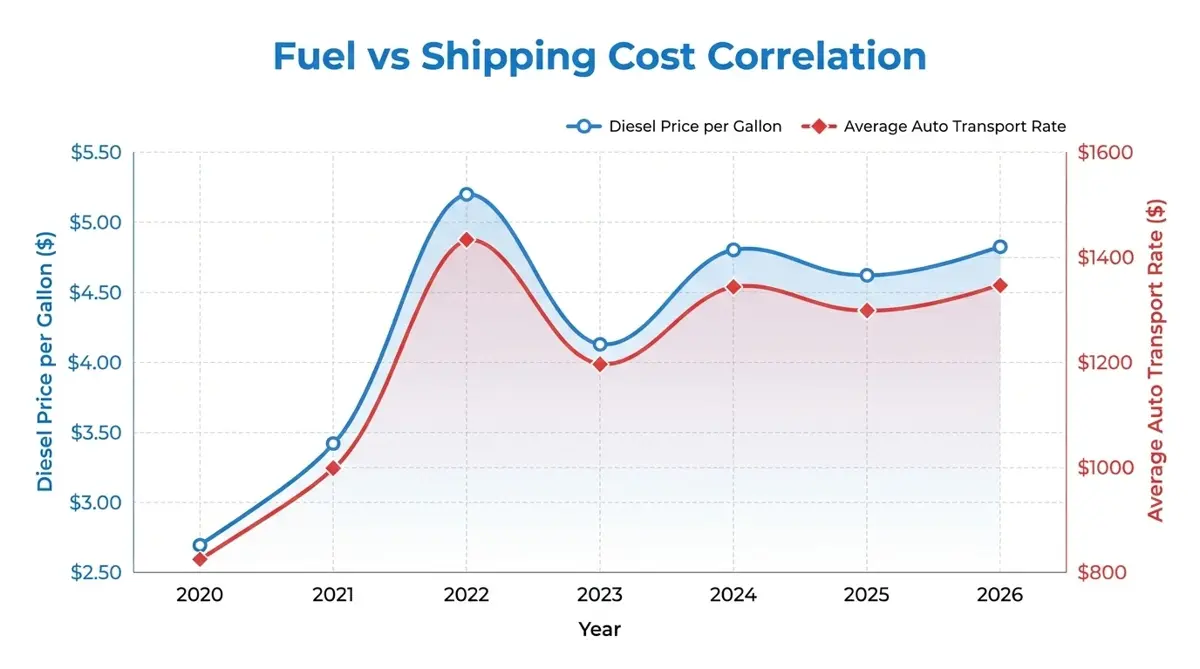
Fuel vs Shipping Cost Correlation Chart 2020-2026
Fuel surcharges are the mechanism carriers use to pass fuel cost volatility through to shippers, and they're one of the most misunderstood line items in shipping. A fuel surcharge is a variable percentage or flat fee added to the base transport rate that fluctuates with diesel prices. When diesel rises, the surcharge rises. When diesel falls, the surcharge falls. The idea is that the base rate covers the carrier's fixed costs (truck payment, insurance, driver pay, maintenance) while the surcharge covers the variable fuel cost. In the auto transport world, fuel surcharges are often already baked into the quote you receive -- unlike commercial freight where they're a separate line item. When you get a binding quote from American Auto Shipping, the fuel cost is included. But it's worth understanding that if you're comparing a quote from January to one from July, the difference may be almost entirely fuel-driven.
Here's how fuel surcharges are typically calculated in the trucking industry. Most carriers use the DOE (Department of Energy) weekly diesel price report as their baseline. They set a floor -- say $3.00/gallon -- where no surcharge applies. For every $0.10 increase above that floor, the surcharge increases by a set percentage (typically 0.3-0.5% of the linehaul rate). So if diesel is at $4.00/gallon -- that's $1.00 above the $3.00 floor, or ten $0.10 increments -- the surcharge would be 3-5% of the base rate. At $5.00/gallon, it jumps to 6-10%. These numbers compound: a 10% fuel surcharge on a $1,000 base rate is $100 extra. On a $1,500 enclosed transport quote, it's $150. Understanding this calculation helps you interpret why rates move and when to expect changes.
Regional fuel price variations create meaningful differences in shipping costs between corridors. California consistently has the highest diesel prices in the country -- often $1.00-$1.50 per gallon above the national average due to state fuel taxes, cap-and-trade programs, and renewable fuel mandates. The Gulf Coast states (Texas, Louisiana, Mississippi) typically have the lowest diesel prices thanks to proximity to refineries. What this means for you: a shipment originating in California costs more than the same distance shipment originating in Texas, all else being equal, because the carrier is fueling up at California prices for at least part of the route. Routes that run heavily through the Northeast and West Coast -- where fuel prices are highest -- carry a premium. Routes through the South and Midwest, where fuel is cheaper, tend to be more affordable per mile.
The fuel cost breakdown for a typical auto transport shipment looks like this. Take a 1,500-mile shipment quoted at $900 for open transport of a standard sedan. Of that $900, approximately $270-$360 (30-40%) goes directly to fuel. Another $180-$225 (20-25%) covers driver compensation. Equipment costs (truck payment, trailer, maintenance, tires) eat $135-$180 (15-20%). Insurance runs $45-$90 (5-10%). The broker's fee (coordination, customer service, carrier vetting, technology) takes $90-$135 (10-15%). That leaves the carrier with a thin operating margin of $0-$45 (0-5%). These are tight numbers -- which is why fuel price changes hit so hard. A $0.50/gallon diesel increase on this route adds roughly $50-$65 in fuel cost. If the carrier can't pass that through to the shipper, it wipes out their entire margin.
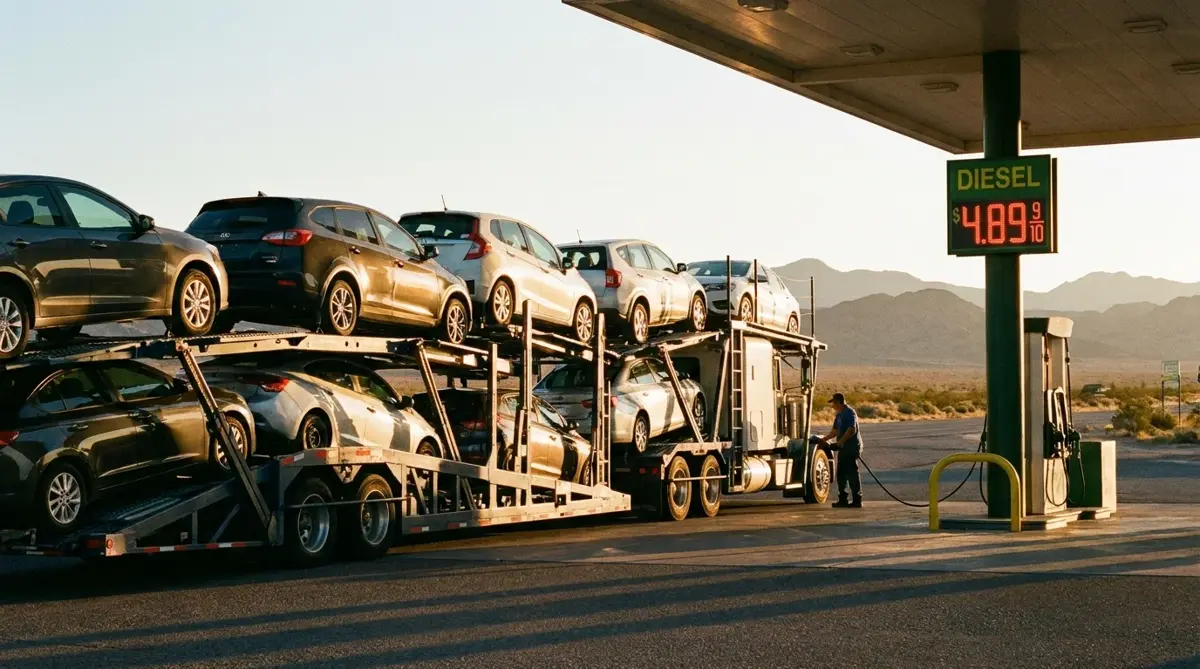
Car carrier truck refueling at a diesel station
So what can you do when fuel prices are high? Here are practical strategies we recommend to our customers. First, be flexible on dates. When fuel is expensive, carriers are even more selective about which loads they accept because every empty mile costs more. A load that fits neatly into their existing route saves fuel versus a load requiring a 100-mile detour. Giving a 3-5 day pickup window means more carriers can match your load efficiently. Second, consider terminal-to-terminal pickup and delivery instead of door-to-door. Dropping off your vehicle at a carrier's terminal (usually near a major highway interchange) eliminates the detour into residential neighborhoods, which saves fuel and can knock $50-$100 off your quote. Third, ship during off-peak months. Summer peak season compounds high fuel prices with high demand -- the worst combination for your wallet. January and February have both lower demand and (historically) lower fuel prices.
Another tip: consolidate shipments when possible. If you're shipping two vehicles, booking them together on the same order costs less per-vehicle than two separate bookings because the carrier picks up both at the same stop, saving fuel and loading time. Multi-vehicle discounts of 10-15% are common for this reason. Also, longer-distance shipments are actually more fuel-efficient on a per-mile basis. A 2,500-mile cross-country run has a lower per-mile fuel cost than a 500-mile regional move because the truck achieves steady-state highway fuel economy for most of the trip, versus the stop-and-go of shorter urban routes. If you have the flexibility to batch your shipping needs into a single longer move rather than multiple short ones, you'll pay less per mile.
Looking ahead, several trends will shape the fuel-shipping rate relationship in the coming years. Electric and hydrogen-powered semi trucks are entering the market, but adoption in the auto transport sector is minimal in 2026 -- the weight and range limitations of current electric trucks make them impractical for fully loaded car haulers running cross-country routes. Renewable diesel and biodiesel blends are more promising in the near term, but they're currently priced at or above conventional diesel in most markets. The most likely scenario for the next 2-3 years is continued diesel price volatility in the $3.50-$5.00 range, driven by global crude oil markets, refining capacity, and regulatory policy. For shippers, this means building a fuel buffer into your shipping budget and taking advantage of lower-price periods when they occur.
At American Auto Shipping, our AI-powered marketplace factors real-time fuel prices into every quote automatically. When diesel drops, our quotes reflect it. When diesel rises, we don't hide the increase -- we show you a transparent, binding price that includes current fuel costs. We've been navigating fuel price cycles for 27 years, and our technology gives you the same real-time market intelligence that carriers use to price their services. Get a quote on our platform -- 60 seconds, no obligation, and the price you see includes everything, fuel and all.
Key Takeaways
- •How much of my car shipping cost is fuel?
- •How much do shipping rates change when diesel prices go up?
- •What is a fuel surcharge in auto transport?
Frequently Asked Questions
Fuel accounts for 30-40% of the total cost of shipping a vehicle. On a $900 shipment, approximately $270-$360 goes directly to diesel fuel. This is why fuel price fluctuations have such a significant impact on auto transport rates.
Historical data shows that when diesel prices increase by $0.50 per gallon, auto transport rates rise 8-12% within 30-60 days. A $1.00/gallon increase in diesel translates to roughly $55-$105 more per vehicle on a cross-country shipment.
A fuel surcharge is a variable fee that adjusts with diesel prices to cover carriers' fluctuating fuel costs. In auto transport, the surcharge is typically included in your binding quote rather than listed as a separate line item. It rises when diesel prices increase and falls when they decrease.
January and February historically offer the best combination of lower fuel prices and lower seasonal demand. Diesel prices also tend to dip in the fall after summer driving season ends. Shipping during these off-peak periods can save you 10-20% compared to summer peak season when both fuel costs and demand are highest.
Yes. Regional fuel prices vary significantly. California diesel is $1.00-$1.50 per gallon above the national average, while Gulf Coast states like Texas have the lowest prices. Shipments originating in high-fuel-cost states carry a premium because carriers fuel up at local prices.
Related Resources
Ready to Ship Your Vehicle?
Get a binding quote in 60 seconds. American Auto Shipping has shipped over 235,000+ vehicles since 1999.
Get a Free QuoteRelated Articles
How Rising Fuel Costs Affect Auto Transport Pricing in 2025
Fuel is the single biggest operating cost for auto transport carriers, and in 2025, prices have been anything but stable. Here’s how fuel surcharges actually work, why your shipping quote fluctuates, and what to know when comparing prices.
How a Nationwide Driver Shortage is Affecting Car Shipping Prices
There's a nationwide driver shortage right now, with industry officials estimating some 60,000 positions have yet to be filled. While major chains such as Walmart and Amazon have so far weathered the issue, car shipping prices are going up as a result. Car transportation is a pretty big industry, de...
OPEC and Auto Transport - How Rising Oil Prices May Affect Your Shipment
OPEC and Auto Transport - How Rising Oil Prices May Affect Your Shipment OPEC (the Organization of the Petroleum Exporting Countries) has reached a deal to limit crude oil production yesterday, and gas prices in some areas are already rising. Now, people are wondering how OPEC and auto transport pri...
How Fuel Prices, Other Factors Impact Your Auto Transport Price
The worldwide economy today is huge, vast and ever-changing. With literally trillions of dollars floating around in hundreds, if not thousands of different currencies, you'd be truly surprised at how price fluctuations or disruptions in one market can impact the prices of goods in another, with perh...
More Guides
How to Ship a Car: The Complete 2026 Guide
A step-by-step walkthrough of the entire car shipping process, from getting your first quote to taking delivery. Everything you need to know to ship a vehicle in 2026.
Car Shipping Costs: Everything You Need to Know in 2026
A detailed breakdown of car shipping pricing by distance, vehicle type, transport method, and season. Learn what actually drives costs and how to avoid bait-and-switch quotes.
Open vs Enclosed Auto Transport: Which Is Right for You?
A head-to-head comparison of open and enclosed auto transport with pros, cons, pricing differences, and practical advice on when to use each method.
How Long Does It Take to Ship a Car?
Transit times by distance, factors that affect timing, pickup windows, and expedited options. Realistic timelines based on 27 years of shipping data.