





★ Key Takeaways
- ✓Summer (Memorial Day → Labor Day) is the busiest auto transport season — demand spikes 30–40% from relocations, military PCS moves, college students, and online car purchases all at once.
- ✓Peak-season rates run 15–20% above the winter/spring baseline — roughly $180–$240 more on a $1,200 coast-to-coast move.
- ✓Holiday weekends (Memorial Day, July 4th, Labor Day) cause short pickup delays as drivers take time off — build a buffer into your timing.
- ✓Book 3–4 weeks ahead and offer a 3–5 day pickup window: flexible-date shipments get matched ~4 days faster and pay 10–15% less.
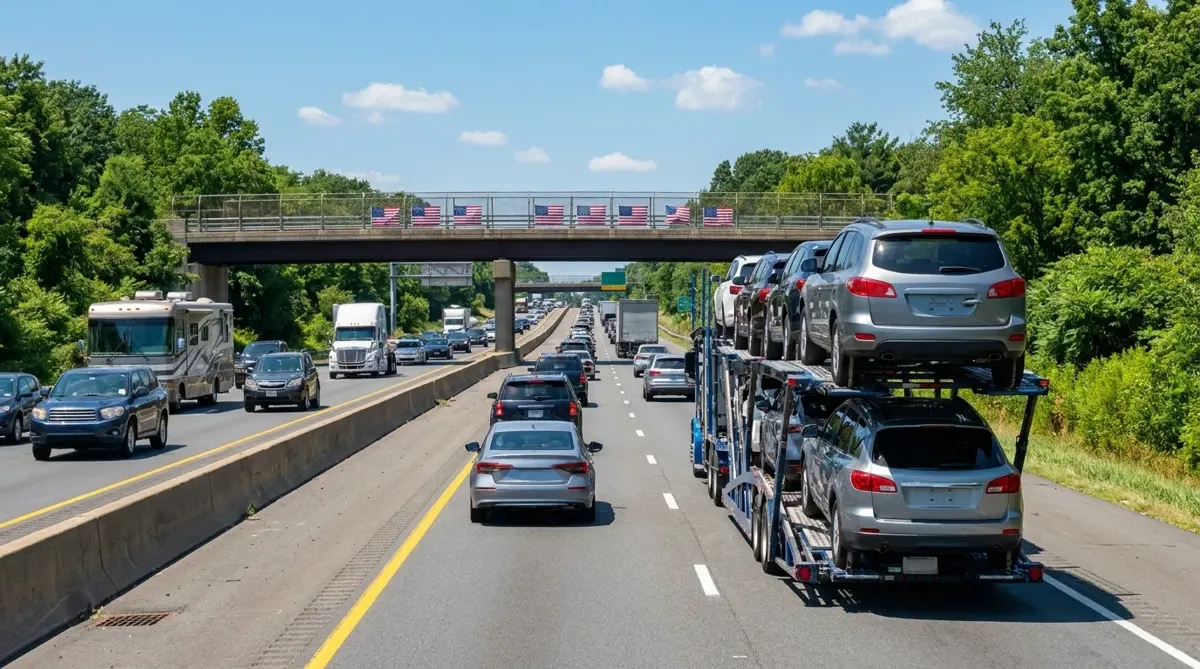
Every year it's the same thing. Memorial Day weekend arrives, the grills come out, the flags go up, and somewhere between the parades and the long weekend -- the auto transport industry shifts into a completely different gear. We've been doing this since 1999 and we've shipped over 235,000 vehicles, so when we say Memorial Day is the starting gun for peak season, we're not guessing. We're reading 25+ years of booking data. The volume spike that begins this weekend doesn't let up until well after Labor Day. If you're planning to ship a vehicle anytime between now and September, this is the article you need to read before you do anything else.
So why does everything ramp up right now? It's not one thing -- it's four or five things all hitting at the same time. First, relocations. Summer is the number one moving season in the United States. Families wait for the school year to end, and then the floodgates open. Corporate relocations, job changes, people chasing opportunity in a new city -- all of that generates vehicles that need to move across state lines. Second, military PCS orders. The Department of Defense processes the majority of Permanent Change of Station moves between May and August. That's hundreds of thousands of service members and their families relocating to new duty stations, and a huge percentage of them need vehicles shipped. Third, college students. Graduating seniors heading home, incoming freshmen moving to campus towns, students doing summer internships in cities hundreds of miles from school. Fourth, online car purchases. People have more free time in the summer, they browse, they buy -- and when you buy a car from a seller 1,500 miles away, it needs to get to you somehow. All of these demand drivers converge right now, and they don't taper off until fall.
Here's something most people don't think about: holiday weekends themselves create a short-term disruption in carrier schedules. Memorial Day weekend is a perfect example. Many owner-operators and company drivers take the long weekend off to spend time with their families -- and they've earned it. That means fewer trucks on the road Friday through Monday. Pickups scheduled for Saturday, Sunday, or Monday frequently get bumped to Tuesday or Wednesday. If you booked a shipment expecting a Memorial Day weekend pickup, there's a decent chance it slides to early the following week. This isn't anyone dropping the ball -- it's just the reality of a holiday in an industry that runs on human beings driving trucks. The same thing happens on the Fourth of July, and again on Labor Day. Factor these gaps into your planning.
“Carrier capacity is fixed in the short term, but summer demand spikes 30–40%. When demand outpaces supply, prices go up — every year, without exception.”
Now let's talk about the part nobody likes hearing -- pricing. Between Memorial Day and Labor Day, auto transport rates climb 15-20% compared to the winter and early spring baseline. On a $1,200 coast-to-coast shipment, that's an extra $180-$240. On shorter regional runs, the dollar amount is smaller but the percentage can be even higher because base prices are lower and the same demand pressure applies. This isn't price gouging -- it's basic supply and demand. Carrier capacity is relatively fixed in the short term. You can't manufacture new car haulers and hire new CDL drivers overnight. But demand spikes 30-40% during summer. When demand outpaces supply, prices go up. Every single year, without exception, for the entire time we've been in this industry.
Ready to ship? Get a real price in 60 seconds.
Our AI marketplace pulls live bids from verified carriers running your route this week — no obligation, no spam.
Get My Free Quote →The single most important thing you can do to save money and avoid delays during summer is to book early. We're talking 3-4 weeks ahead of your desired pickup date. During the off-season, you can often book a week out and get picked up within days. During peak summer, a week's lead time might not be enough -- especially on popular corridors. Last-minute bookings during peak season face two problems simultaneously: fewer available carriers because most are already committed, and higher prices because you're competing with everyone else who waited. Customers who book 3-4 weeks ahead on our platform consistently pay 10-15% less than those who book within a week of needing pickup. The math is clear and it repeats every summer.
Speaking of popular corridors -- certain routes get absolutely hammered during summer. The Florida-to-Northeast corridor is always one of the busiest, with snowbirds who left in October finally bringing their vehicles back north. California to Texas and Texas to California see massive volume from relocations and military moves. The entire Sun Belt -- Arizona, Nevada, Florida, Georgia -- generates disproportionate outbound volume as people who moved south for the winter head back to their primary homes. New York to Florida, LA to Seattle, Chicago to Dallas -- these high-traffic lanes fill up fast. If your shipment happens to be on one of these corridors during peak season, expect carrier availability to be tighter and be even more intentional about booking early.
Flexibility is your best friend during peak season -- and that applies to dates, not just price. We always tell customers to offer a 3-5 day pickup window rather than demanding a specific date. During summer, that advice becomes even more critical. Carriers are juggling full trailers with seven to nine vehicles, each with different origins and destinations. A driver who's already routed through your area with one open spot is going to prioritize the customer who says 'anytime between June 10th and June 14th' over the one who insists on June 12th and no other day. On our platform, flexible-date shipments during summer get matched with carriers an average of 4 days faster than rigid-date requests. And they pay less. Flexibility isn't just a nice-to-have during peak season -- it's a competitive advantage that directly translates to faster service and lower cost.
This is where the American Auto Shipping marketplace earns its keep. Our AI doesn't sleep through summer -- it works harder. When volume surges, our route-scanning technology continuously analyzes carrier positions, available capacity, real-time pricing trends, and corridor congestion across the entire national network. Instead of a dispatcher manually calling carriers to check availability -- which is how most of the industry still operates -- our AI is matching your shipment with carriers who are already routed through your area, who have open spots on their trailer, and whose route economics make your shipment profitable for them at a competitive price for you. During peak season, that efficiency advantage compounds. Every carrier matched faster means one less shipment competing for the next available truck. The system gets smarter as volume increases because it has more data points to optimize against.
Before we wrap up -- take a moment this weekend to remember what Memorial Day is actually about. It's not just the start of summer or a three-day weekend. It's a day to honor the men and women who gave their lives in service to this country. A lot of military families are among our most loyal customers -- PCS moves, deployments, base transfers. We've shipped vehicles for service members since 1999 and we never take that relationship for granted. If you're a military family reading this and you've got a summer PCS move coming up, get your quote in early. We offer military discounts and our platform is built to handle the specific requirements of military vehicle shipments, including storage coordination and flexible delivery windows.
So here's the bottom line: summer shipping season is officially here. Rates are climbing, carrier capacity is tightening, and the busiest three months of the year are dead ahead. But none of that has to catch you off guard. Book 3-4 weeks early. Be flexible on your pickup dates. Understand that holiday weekends will cause short delays. And let our marketplace AI do the heavy lifting of finding you the best carrier at the best price on your specific route. We've navigated 25+ summer shipping seasons and over 235,000 vehicles -- we know how this works. Get a quote on our platform today. It takes 60 seconds, it's binding, and the earlier you lock in your rate, the better positioned you'll be for the months ahead.
About the Author
Dave Armstrong is one of American Auto Shipping's longest-tenured team members. As content manager and strategist, most of what you read on this website came from him. He has extensive knowledge of the auto transport industry, having spent time in every role the business has to offer.
Learn More About Auto Shipping
Shipping To or From These Areas?
Popular routes