





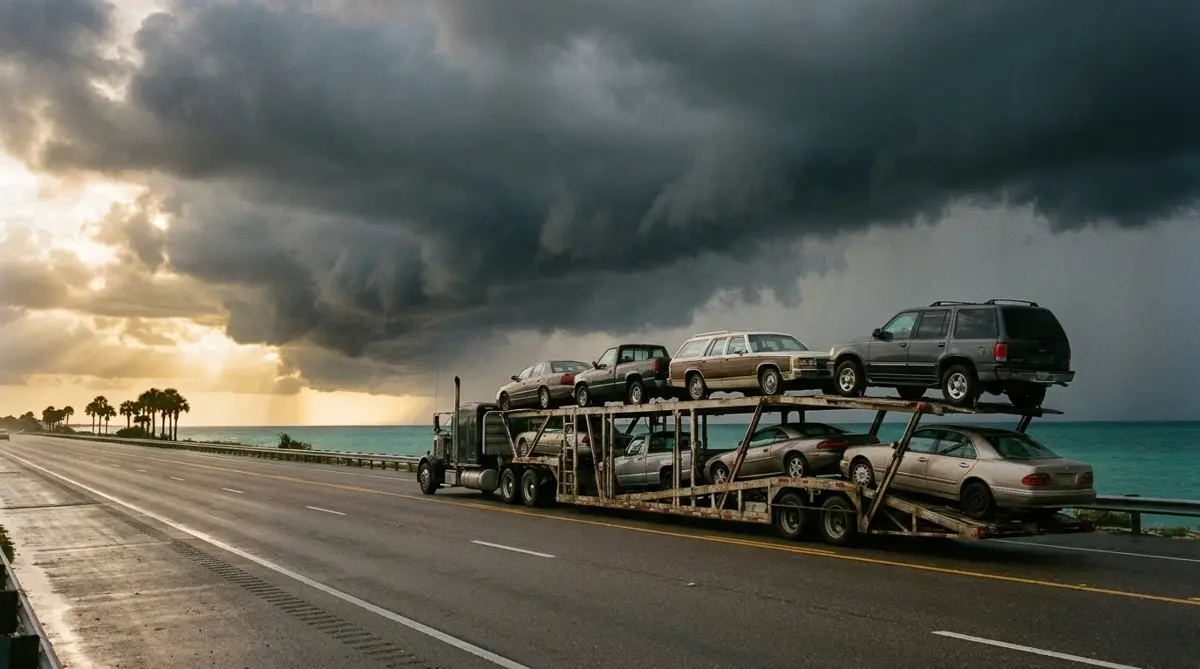
★ Key Takeaways
- ✓Hurricane season runs June 1 through November 30 -- NOAA's 2026 forecast calls for an above-average season with 14--21 named storms, including 6--10 hurricanes.
- ✓When a named storm threatens a Gulf Coast corridor, auto transport rates on evacuation routes spike 25--50% within 48 hours as demand surges and carrier supply drops.
- ✓Post-storm disruptions last 1--3 weeks: flooded roads, closed highways, and repositioned carriers create backlogs that affect pricing and pickup times even on routes hundreds of miles from the impact zone.
- ✓Standard carrier cargo insurance covers transit damage but NOT acts of God (hurricanes, floods, tornadoes) -- confirm your personal auto insurance covers vehicles in transit before shipping during storm season.
- ✓The safest strategy: ship early in the season (June--July), monitor NOAA forecasts, build a 5--7 day buffer into your timeline, and avoid booking during active storm watches on your corridor.
Hurricane season is here. It officially started June 1st and runs through November 30th, and NOAA's 2026 forecast is calling for an above-average season -- 14 to 21 named storms, with 6 to 10 expected to reach hurricane strength. If you live in Florida, Texas, Louisiana, Mississippi, Alabama, or anywhere along the Gulf Coast -- or if you're shipping a vehicle to or from those states anytime in the next five months -- this directly affects you. We've been in the auto transport business since 1999, and we've navigated every major hurricane season of the past 27 years, including Katrina, Harvey, Irma, Ian, and the back-to-back storms of 2024. The patterns are consistent even when the storms aren't, and understanding how hurricanes affect the auto transport market will save you money, time, and a lot of stress.
Let's start with the most immediate impact: pricing. When a named storm enters the Gulf of Mexico or tracks toward the Atlantic coast of Florida, auto transport rates on affected corridors spike -- and they spike fast. Within 48 hours of a hurricane watch being issued, we typically see rates on evacuation routes jump 25 to 40 percent. During Hurricane Ian in 2022, Florida outbound rates doubled on some corridors as residents scrambled to get vehicles out of the storm's path. The pricing surge is driven by simple supply-and-demand physics. Demand skyrockets as people try to move vehicles to safety. At the same time, carrier supply drops because drivers are either evacuating themselves, avoiding the affected area entirely, or repositioning to safer routes. Fewer trucks plus more demand equals higher prices. There's no way around it.
| Scenario | Pricing impact | Delay impact |
|---|---|---|
| No active storms | Normal seasonal rates | Standard 3--7 day transit |
| Named storm 5+ days out | +10--15% on affected corridors | +1--2 days as carriers reroute |
| Hurricane watch (48 hrs) | +25--40% evacuation-route surge | +3--5 days; some carriers pause |
| Hurricane warning / landfall | +40--50%+; limited availability | +7--14 days; roads closed, backlog builds |
| Post-storm recovery (1--3 wks) | +15--25% as market normalizes | +3--7 days from backlog and detours |
The corridor-specific effects are important to understand. Florida is the most hurricane-exposed state for auto transport because it's a peninsula -- there's essentially one way in and one way out by road, and I-95 and I-75 are the primary arteries. When a storm threatens South Florida, every northbound route out of the state gets congested -- both for personal vehicles evacuating and for car haulers trying to complete deliveries or reposition. Texas Gulf Coast corridors -- Houston, Galveston, Corpus Christi -- face similar bottlenecks because I-10 and I-45 become evacuation highways. Louisiana is particularly vulnerable because New Orleans and the southern parishes have limited evacuation routes, and flooding can close roads for days or weeks after a storm passes. Mississippi and Alabama coastlines are shorter but still see major disruptions when Gulf storms make landfall.
“The auto transport industry doesn't shut down for hurricane season -- but it adapts fast, and the shippers who adapt with it save the most money and avoid the worst delays.”
What a lot of people don't realize is that hurricane disruptions extend far beyond the direct impact zone. When a major storm hits the Gulf Coast, it doesn't just affect shipments going to or from that area -- it disrupts the entire regional carrier network. Carriers that were running routes through the affected area have to reroute, which delays their other pickups and deliveries hundreds of miles away. A carrier running a load from Atlanta to Houston who has to reroute around a storm-damaged area in Louisiana adds time and fuel costs to that trip, which affects the next customer's pickup in Phoenix. We've seen a single major hurricane create ripple-effect delays across the entire Southeast carrier network for two to three weeks after the storm passes.
Ready to ship? Get a real price in 60 seconds.
Our AI marketplace pulls live bids from verified carriers running your route this week — no obligation, no spam.
Get My Free Quote →Insurance is the critical piece that most shippers don't think about until it's too late. Standard carrier cargo insurance covers damage that occurs during normal transport operations -- a strap failure, a loading incident, road debris. What it typically does NOT cover is acts of God -- hurricanes, floods, tornadoes, and other natural disasters. If your vehicle is on a carrier trailer when a hurricane strikes and the trailer is damaged or overturned, the carrier's insurance may deny the claim under the act-of-God exclusion. This is where your personal auto insurance becomes essential. Before shipping during hurricane season, call your insurance company and confirm that your policy covers your vehicle while it's in transit on a carrier. Most comprehensive policies do, but you need to verify it -- don't assume. If there's a coverage gap, ask about adding a temporary transit rider. It's a small premium for significant peace of mind.
Post-storm recovery is where the real logistical headaches begin. After a hurricane makes landfall, the immediate aftermath includes closed highways, flooded roads, downed power lines, and debris blocking major routes. Even highways that aren't directly damaged may be closed for emergency vehicle access or become one-way evacuation routes. Carriers can't operate on closed roads, and the ones that can operate are dealing with detours that add hours or days to transit times. Then there's the fuel situation -- gas stations in the impact zone may be out of service, and diesel supply can be disrupted for days. This is why post-storm pricing stays elevated for one to three weeks even after roads reopen. Carriers are burning more fuel on longer detour routes, dealing with backlogged loads that piled up during the storm, and operating in an environment where everything takes longer than normal.
So what's the smart strategy for shipping during hurricane season? First, if you have flexibility on timing, ship early in the season. June and early July are statistically the least active period for Gulf hurricanes -- the peak runs August through October. Getting your vehicle moved before the peak window eliminates the storm risk entirely. Second, monitor the NOAA forecasts. You don't need to be a meteorologist -- just check the National Hurricane Center's outlook weekly. If a tropical system is developing and your corridor is in its potential path, either accelerate your booking to beat the storm or delay until it passes. Don't try to ship during an active hurricane watch -- it's more expensive, riskier, and likely to result in delays.
Third, build a buffer into your timeline. During hurricane season, we recommend adding 5 to 7 days to your expected transit window for any Gulf Coast corridor. This accounts for potential weather-related delays, carrier rerouting, and the general unpredictability of tropical weather. If you need your vehicle by a specific date -- say, for a job start or a move-in -- book with enough lead time that a 3-to-5-day delay won't ruin your plans. Fourth, communicate with your carrier and your shipping platform. On our marketplace, we monitor weather patterns along every active corridor and proactively communicate with customers when storms threaten their routes. If a reroute is necessary, our AI recalculates the best alternative route and carrier match in real time.
One thing we want to be clear about: the auto transport industry doesn't shut down for hurricane season. Carriers run Gulf Coast routes every day from June through November, and the vast majority of shipments during hurricane season complete without any storm-related issues. Hurricanes are disruptive but relatively infrequent events on any specific corridor. The key is awareness and preparation, not avoidance. Ship when you need to ship, but do it with eyes open -- know the risks, understand the insurance implications, build in timeline buffers, and work with a platform that monitors conditions in real time and communicates proactively.
If you're planning a shipment to, from, or through any Gulf Coast state this season, get a quote on our platform now. It takes 60 seconds and it's binding. Our AI factors current weather conditions and seasonal patterns into every quote, and our carrier network includes experienced operators who've been running Gulf Coast routes through hurricane seasons for decades. We've shipped over 235,000 vehicles since 1999 -- through Katrina, Harvey, Irma, Ian, and everything in between. Whatever this hurricane season brings, we've seen worse and we know how to navigate it. Get ahead of the season, book early, and let us handle the logistics so you can focus on keeping your family safe.
About the Author
Dave Armstrong is one of American Auto Shipping's longest-tenured team members. As content manager and strategist, most of what you read on this website came from him. He has extensive knowledge of the auto transport industry, having spent time in every role the business has to offer.