





★ Key Takeaways
- ✓Get paid and let the funds clear before the car leaves. Once it is on a truck heading out of state, your leverage is gone.
- ✓Whoever books the transport controls it. If the buyer books, they choose the carrier and the dates -- fine, as long as you are not the one absorbing the risk if it goes wrong.
- ✓The Bill of Lading is your evidence. Photograph the car thoroughly at pickup and make sure the condition report matches, because a damage dispute after delivery comes back to what was documented when it left.
- ✓Remove your plates and cancel insurance only after the car is delivered and the title transfer is done -- not on pickup day.
- ✓File the release of liability with your state as soon as the sale completes. Until you do, that vehicle is still associated with you.
Search anything about auto transport and you will find a hundred guides written for the person receiving the car. Almost nothing is written for the person handing it over, which is strange, because the seller carries the risk that actually matters. The buyer's worst day involves a vehicle arriving later than promised. The seller's worst day involves a vehicle that is already 1,500 miles away and a payment that turned out not to be real. So let's do this one from your side of the driveway.
The single rule that prevents most bad outcomes: get paid, and let the money actually clear, before the car goes on a truck. Not a check in hand -- cleared funds in your account. A cashier's check can be forged and will bounce days later, after your vehicle has crossed several state lines. A wire that has landed and settled is real. An escrow service both parties agreed on is real. If a buyer pushes back on waiting for funds to clear, that is information about the buyer, and you should treat it that way.
Next question: who books the shipment? Either works, but be clear about what you are agreeing to. If the buyer books and pays for transport, they choose the carrier, they set the pickup window, and the transport relationship is theirs -- your job is simply to have the vehicle available and release it properly. That is usually the cleanest arrangement for a seller. If you book it as a courtesy, you have taken on the scheduling and the carrier relationship for a car you no longer own, which is a lot of responsibility for no upside.
“The buyer's worst case is a car that shows up late. The seller's worst case is a car that shows up somewhere they cannot reach with money that never arrives.”
Whatever you agree, put the pickup logistics in writing between you and the buyer: who is present at pickup, what happens if the driver arrives outside the window, and who is responsible if the vehicle is not available when the truck shows up. Carriers schedule tightly. A missed pickup can bump a shipment by days, and you do not want to be improvising that conversation with a stranger who has already paid you.
Ready to ship? Get a real price in 60 seconds.
Our AI marketplace pulls live bids from verified carriers running your route this week — no obligation, no spam.
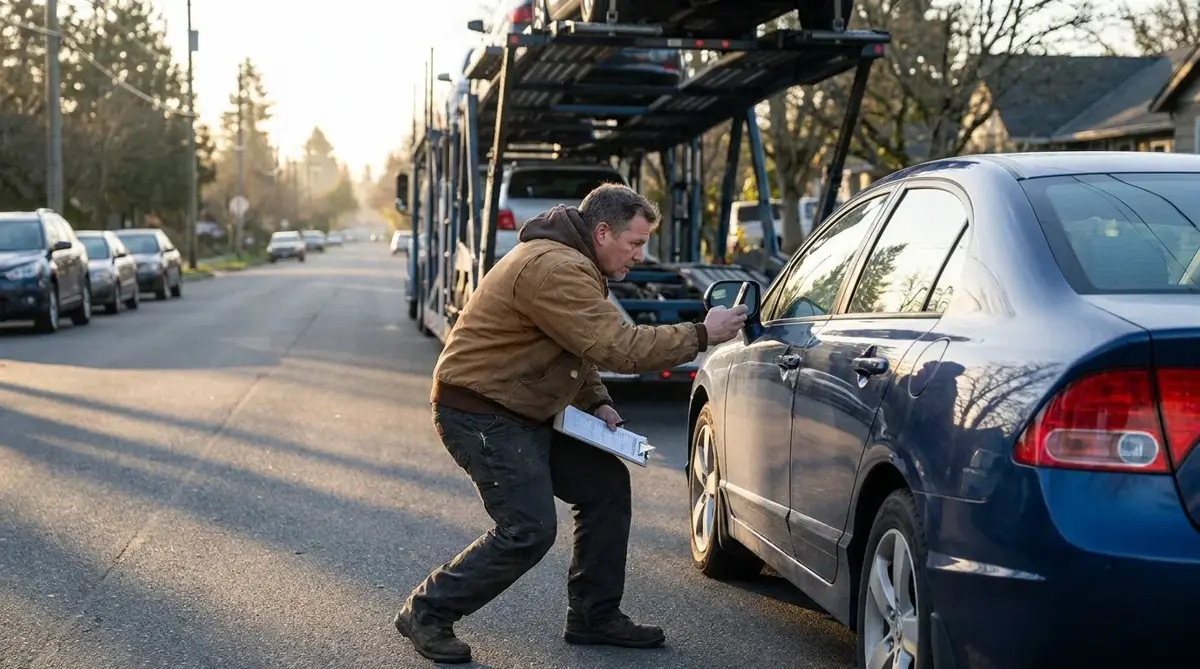
Get My Free Quote →Now the part that protects you if anything is disputed later: documentation at pickup. Photograph the entire vehicle before the driver loads it -- all four sides, the roof, the wheels, the interior, the odometer, and close-ups of any existing damage. Do it in daylight if you possibly can. Then go through the Bill of Lading with the driver and make sure the condition report they write matches what you both just looked at. Sign it, and keep your copy. If the buyer later claims the car arrived with damage, that document and those timestamps are the entire argument.
There is a version of this where a seller is too helpful and it costs them. Do not detail the car so thoroughly that existing damage becomes hard to see in your photos. Do not leave personal belongings in the vehicle -- carriers generally are not licensed to haul household goods, items are not covered by cargo insurance, and it adds weight the driver did not plan for. Take a quarter tank of fuel or so; a full tank is unnecessary weight and nobody thanks you for it.
After the car is gone, there is administrative work that people forget and later regret. Do not cancel your insurance the moment the truck pulls away -- keep coverage until the vehicle is delivered and the title transfer is complete, because until then you may still have an interest in it. Remove your license plates before it goes if your state requires you to keep them. And file the release of liability, notice of transfer, or whatever your DMV calls it, as soon as the sale completes. Until that paperwork lands, tickets and tolls generated by the new owner can find their way back to you.
One more thing worth saying plainly: it is entirely normal to ship a car to a buyer you have never met, and most of these transactions are unremarkable. The precautions above are not because out-of-state buyers are suspect -- they are because the sequence of events in a long-distance sale removes your ability to fix things after the fact. Get the order right and it is a genuinely easy way to sell a car to a much larger pool of buyers than your local market.
American Auto Shipping is an AI-powered shipping marketplace -- not a broker, not a carrier. Whether you are booking the move or your buyer is, verified carriers compete for the route and the winning carrier contracts directly with whoever booked. Get a free quote on our platform or call (800) 930-7417.
About the Author
Dave Armstrong is one of American Auto Shipping's longest-tenured team members. As content manager and strategist, most of what you read on this website came from him. He has extensive knowledge of the auto transport industry, having spent time in every role the business has to offer.