





★ Key Takeaways
- ✓Open motorcycle transport typically runs $300-$800; enclosed runs roughly $500-$1,500; full crating for rare or overseas-bound bikes can reach $800-$2,400.
- ✓Distance is the biggest cost driver, but method, bike size, and how it's secured all move the price -- a cross-country haul can triple a short regional move.
- ✓Enclosed is worth the premium for collector, custom, and high-value bikes; open transport is perfectly fine for standard commuters and most cruisers.
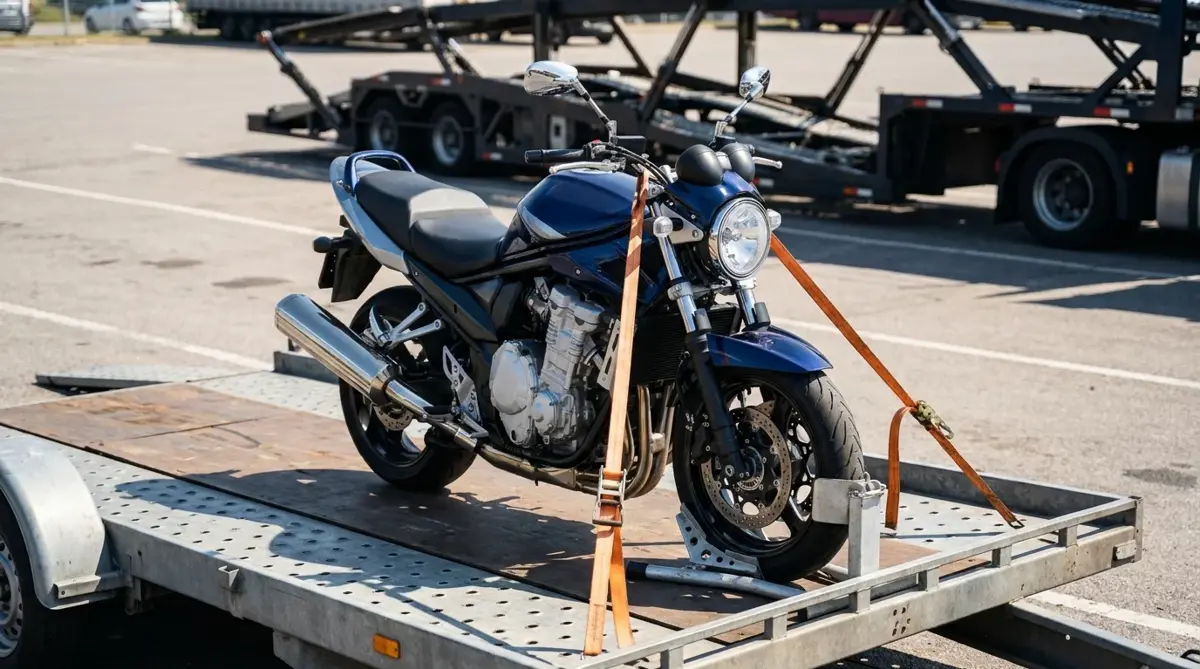
- ✓A proper motorcycle carrier uses a front-wheel chock and soft straps over the frame or triple clamp -- never let anyone secure a bike by the handlebars alone.
- ✓Prep pays off: fold the mirrors, disable the alarm, leave minimal fuel, and photograph existing scratches before it loads.
We've been arranging vehicle transport since 1999, and one of the questions we get wrong-footed by most often is people assuming a motorcycle ships like a small car. It doesn't. A car sits on four wheels with a low, stable center of gravity -- you strap it down and it isn't going anywhere. A motorcycle has two contact points, a tall stance, and a real tendency to tip if it isn't secured correctly. That difference is why motorcycle shipping has its own equipment, its own methods, and its own pricing. So let's walk through what it actually costs to ship a bike in 2026, and just as importantly, what you're paying for.
Start with the number most people came here for. For a standard motorcycle moving open transport, you're generally looking at $300 to $800. A short regional hop -- say a couple hundred miles -- can land near the bottom of that range, while a coast-to-coast move pushes toward the top and beyond. Enclosed transport, where your bike rides inside a sealed trailer protected from weather and road debris, typically runs $500 to $1,500 depending on distance. And full crating -- where the bike is boxed, immobilized, and often prepped for an overseas container -- runs $800 to $2,400. Those are real market ranges, not lowball teasers, and the spread is wide because the method matters as much as the mileage.
| Method | Typical cost | Protection | Best for |
|---|---|---|---|
| Open transport | $300-$800 | Standard -- exposed to weather and road | Commuters, cruisers, standard bikes |
| Enclosed transport | $500-$1,500 | High -- fully enclosed, shielded | Collector, custom, high-value bikes |
| Crated / palletized | $800-$2,400 | Maximum -- boxed and immobilized | Rare, exotic, or overseas-bound bikes |
Distance is still the single biggest lever on price, the same as it is with cars. But with motorcycles, the method you choose can move the number just as much. Think of it this way: an open carrier can fit several bikes on a single run, so the cost gets spread across the load and open stays affordable. An enclosed trailer carries fewer units and offers far more protection, so you pay for both the scarcity and the security. Crating is labor-intensive -- somebody physically builds a crate around your bike -- so it sits at the top. Where you land depends on what your bike is worth to you and how far it's going.
“A motorcycle has two contact points and a high center of gravity -- how it's secured matters far more than it does with a car. Method is everything.”
So which method actually makes sense for your bike? Here's how we counsel customers. If you're moving a standard commuter, a cruiser, or a bike you ride hard and don't baby, open transport is completely reasonable -- it's how the majority of motorcycles ship and they arrive just fine. If you own something collectible, custom, freshly restored, or simply expensive, enclosed is worth every dollar of the premium. You are paying to keep road grime, weather, and prying eyes off a machine that's hard or impossible to replace. Crating is a niche choice -- mostly for rare bikes, show pieces, or anything heading into an ocean container for an international move.
Ready to ship? Get a real price in 60 seconds.
Our AI marketplace pulls live bids from verified carriers running your route this week — no obligation, no spam.
Get My Free Quote →Now the part that separates a good shipment from a damaged one: securement. A motorcycle should be loaded onto a carrier with a front-wheel chock that holds the front tire upright, then secured with soft straps over the frame, the triple clamp, or dedicated tie-down points -- with the suspension gently compressed so the bike can't bounce. What you never want to see is someone cranking straps down on the handlebars alone. Bars aren't structural in the way people assume; over-tensioning them can bend components and stress the fork seals. When you're comparing carriers, ask exactly how they secure bikes. The good ones will describe a chock-and-soft-strap setup without hesitation.
A little prep on your end goes a long way. Fold in the mirrors and retract or remove anything that sticks out and could catch during a tight load. Disable the alarm so it isn't shrieking on the trailer. Leave only a small amount of fuel in the tank -- enough to move it on and off, not a full tank of extra weight and fire risk. And do what we tell every customer regardless of what they're shipping: photograph the bike from every angle, including existing scratches and scuffs, with timestamps, before it loads. If a question ever comes up at delivery, those photos are your proof of the condition it left in.
Insurance works a little differently in people's heads than it does in reality, so let's be clear. A legitimate carrier hauling your motorcycle carries cargo insurance that covers the bike in transit, but coverage details, deductibles, and exclusions vary by carrier. Before you book, ask for the carrier's cargo coverage and confirm it's adequate for what your bike is worth -- a $30,000 custom build needs more coverage than a $4,000 commuter. This is one more reason the cheapest quote isn't automatically the best one; a rock-bottom price sometimes comes with rock-bottom coverage.
Here's where our platform earns its keep. American Auto Shipping is a marketplace -- we're not a broker and we don't own trucks. When you tell us about your bike and your route, we put that shipment in front of vetted carriers who actually specialize in motorcycles, and they compete for the job. That competition is what gets you a real market rate instead of a single take-it-or-leave-it number, and our matching finds carriers who already run motorcycle-equipped trailers on your corridor. Get a free quote on our platform or call us at (800) 930-7417, tell us whether you're leaning open or enclosed, and we'll show you what it actually costs to move your bike -- with carriers competing to earn the load.
About the Author
Dave Armstrong is one of American Auto Shipping's longest-tenured team members. As content manager and strategist, most of what you read on this website came from him. He has extensive knowledge of the auto transport industry, having spent time in every role the business has to offer.