





We've talked about some of the most popular (and unpopular) car transport locations in the past. We've talked about which cities see the most traffic, which ones don't see as much. And, we've talked about the reasons behind it and why customers go where they go and do what they do. But one thing we haven't really touched on are the places that carriers just can't stand traveling to.
But there are a lot, and the easiest way to see them is to look at the top locations for freight-truck congestion. Now, this doesn't just cover auto shippers, but rather truckers from all different industries. But they share some basic traits, like the fact that they haul goods for other people. Regardless, here's some of the worst places to ship a car, according to the American Transportation Research Institute. You can see the full Top 100 list here .
In the interest of full disclosure, the Top-100 list we linked is actually the top-100 Worst Bottlenecks in America. However, these bottlenecks have a definite adverse affect on car shipping carriers, and many will look to avoid those areas if possible. Of course, it's hardly possible to avoid all of them all the time, but still, this will hopefully give you a good idea of what carriers have to contend with when on the road.
The Top-5 Worst Places to Ship a Car, According to the ATRI #5 - I-71 and I-75 interchange, Cincinnati, OH
Ready to ship? Get a real price in 60 seconds.
We put your shipment in front of licensed auto transport companies running your route this week, and they send you their best offers — no obligation, no spam.
Get My Free Quote →I-71 and I-75 connect right in downtown Cincinnati before crossing the Ohio River into Covington, Kentucky. They actually merge right there too (or diverge, if you're heading north). Regardless, it's a little surprising, but looking at the interchange you can easily see how it can cause backups and delays.
#4 - I-65 at I-64/I-71, Louisville, KY
Another intersection in the east-south-central region, the area where I-64, I-65 and I-71 (essentially) meet up can be a giant cluster**** if you're not familiar with the route. And even then, experienced auto shippers can have a hard time navigating the scrum that is that interchange. Take a look at it on Google Maps to see for yourself. This isn't surprising considering it flows right into downtown Louisville.
#3 - I-290 at I-90/I-94, Chicago, IL
Does it surprise anyone that Chicago is on this list? This intersection is where I-290 and I-90/I-94 (both run along the same roads through this area of Chicago) meet, right in the heart of Downtown. Carriers have a hard enough time getting to and from downtown areas, but throw in a bottleneck like this and it gets even worse. Notice too how many people are in Chicago and how many people use those interstates on a daily basis.
#2 - I-95 at SR 4, Fort Lee, NJ
Finally, a New Jersey intersection! Honestly, we were surprised that more of the top-1o worst places to ship a car weren't in New York or New Jersey, considering how horrible traffic is there. This one, though, isn't surprising. I-95 and SR 4 connect just west of the New Jersey Turnpike, which...well, which naturally leads to bottlenecks, thanks to tolls. I-95 is heavily tolled through the New York/New Jersey area, which can and does raise auto shipping prices for many people. And with the bottleneck at the entrance to the Turnpike, shipments tend to take longer, too.
#1 - I-285 at I-85, Atlanta, GA
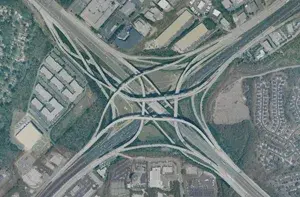
Ha! Bet you weren't expecting Atlanta to top this list! The truth, though, is far from what you may expect (one might call it ironic). This particular intersection, seen here via Google Maps , is known as \"Spaghetti Junction.\" Its real name is the Tom Moreland Interchange. It's not even in Atlanta, but rather sits northeast, and is still the worst intersection for auto shippers in the nation. It is but one of seven interchanges in the Atlanta area that have made ATRI's list of Top-100 worst bottlenecks in the country.
Don't worry - auto transporters can and will brave these areas in the interest of delivering cars. But these bottlenecks occur in some of the most popular shipping locations in their respective regions, especially the Atlanta area and the New Jersey area. So next time you're wondering why it's taking so long to get your car to you, think about some of the worst bottlenecks and ask yourself if your carrier might be in one of them.
Get free quotes to ship a car with American Auto Shipping
If you're interested in shipping a car, regardless where from or to, take a minute to fill out our free form. It really is free and will get you a free quote to ship your vehicle right away. We clear every company we work with for dependability and reliability and that includes making sure they are fully licensed and insured. If you have questions, need to get a quote over the phone, or are ready to ship, give us a call today at 800-930-7417, toll-free.
About the Author
Dave Armstrong is one of American Auto Shipping's longest-tenured team members. As content manager and strategist, most of what you read on this website came from him. He has extensive knowledge of the auto transport industry, having spent time in every role the business has to offer.
Learn More About Auto Shipping
Shipping To or From These Areas?
Popular routes